


Inflammatory Art
by Emma Van Zandt, 2025 Business Fellow
Curatorial Statement
One of my greatest takeaways from the FASPE experience was the recognition that, as humans, we have a psychological tendency to distance ourselves from those involved in atrocities to avoid confronting the difficult truth of our own potential—even our propensity—to become both victims and perpetrators. This is, in part, why we tend not to grapple with the role of the professional in Nazi Germany, the complicity of the everyman. We assume (or pretend) that some deep, inherent evil drove those involved. We unconsciously draw a line demarcating us and them.
Quietly, we convince ourselves that they were motivated by something wholly alien, something beyond the banal. In doing so, we stop a line of inquiry before it begins: that perhaps we, too, might act wrongly if placed in their circumstances, that perhaps we are much closer to standing in their shoes than we would like to believe.
I left with a sense of urgency about interrogating my own actions, my own moral compass. In conversations with friends, family, and colleagues after the trip, I faced a challenge: how to have the kind of dialogue that inspires reflection and action outside of the focused, intentional environment that FASPE provides. The inertia of everyday life is a strong current. What can break through the comfort of our routines and prompt us to examine the deeply uncomfortable?
Since our trip, I have been reflecting on the role of art as a disruptive force. Art has a unique power to interrogate the structures we’ve built—both in society at large and within our own psyches—that allow us to maintain our sense of separation from wrong, our sense of our own moral superiority and relative safety.
I know I am not alone in my belief in art’s provocative potential. I would go so far as to say this conception of art is now fairly common in the collective consciousness. However, this is a relatively recent phenomenon. It is thanks to a wave of movements in the second half of the 20th century, which encouraged the marriage of the arts and the sociopolitical, that we now benefit from art as a catalyst for reflection, conversation, and change.
I would like to offer a proposal for an exhibition (one that, admittedly, was created free from care for financial, temporal, or spatial constraints). In this exhibition, I have curated a selection of what I would like to call “inflammatory art”: a moniker inspired by Jenny Holzer’s Inflammatory Essays. Here, I view “inflammatory” positively. To me, it is an appropriate term for the kind of art that meets its potential to be incendiary, catalyzing, and subversive, the kind of art that can comfort the disturbed
and disturb the comfortable.
Room 1: Fluxus
The 1960s birthed countercultural movements throughout society. A new generation of youth had come of age, bringing new ideals and a fresh perspective on the existential crises the world faced in the wake of the Second World War—the very generation we discussed in our FASPE conversation about German memory politics.
In the arts, one of the most radical children of the counterculture was Fluxus.
Fluxus’s origins are attributed to composer John Cage and Lithuanian-American artist George Maciunas, but its adherents were multinational and multidisciplinary. New York, Germany, and Japan became major hubs for Fluxus artists into the 70s.
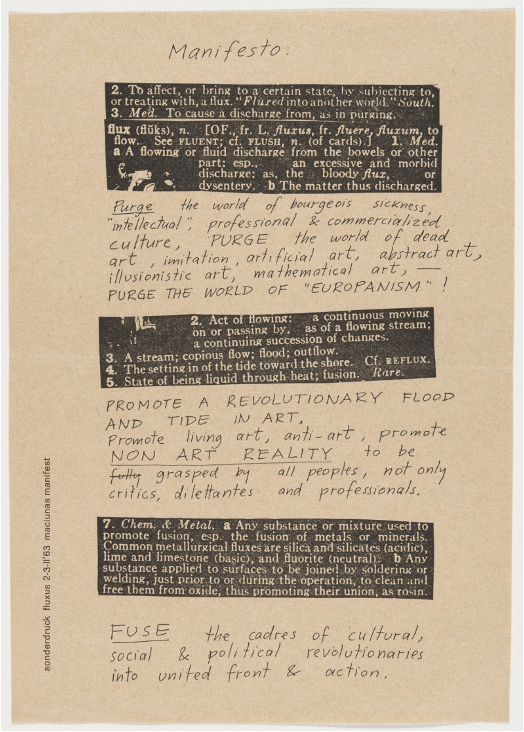
Fluxus was fundamentally contrarian, self-described as “anti-art.” At its core is “flux,” a concept both nebulous and highly specific. In essence, it describes a mode of making: an active state of flow and continuous movement, wherein art becomes more focused on process and experience than product.
Fluxus stood in stark opposition to the detached, rigid, and bourgeois status quo of the “fine arts,” in particular, its direct predecessors, the hard-edged abstraction and Modernist movements of the late 1940s-1950s. These movements, arguably influenced by widespread sociological changes following WWII, sought art removed from social commentary and context.
In Fluxus thought however, it is impossible to understand anything segregated from its context. Bodies, societies, and objects are necessarily and inextricably interrelated. The object is the tissue of connection between people and society, and the role of the artist is to breathe life into revolution.
George Maciunas, Fluxus Manifesto, 1963, offset lithograph1
Wiesbaden, 1962
Fluxus pioneers George Maciunas, Dick Higgins, and Alison Knowles collaborated with German artists Joseph Beuys and Wolf Vostell to organize a series of performances called Fluxfests across Europe. The first event was a set of concerts held over the month of September 1962 in Wiesbaden, Germany. This was known as Fluxus Internationale Festpiele Neuester Musik (Fluxus International Festival of New Music). The festival at Wiesbaden included concerts by Fluxus musicians and performances by Fluxus artists, including Naim Jun Paik’s now-iconic piece Zen for Head (1962).

Fluxus Festival neueste Musik, Wiesbaden, a production of ECG Frankfurt, 19622
Curatorial note: original video to be shown in a dark room. Includes film of: George Maciunas, In memorium to Adriano Olivetti; Emmett Williams, Four Directional Songs of Doubt.; Benjamin Patterson,Variation on Solo for Double Bass; Naim Jun Paik, Zen for Head; Phillip Corner, Piano Activities.
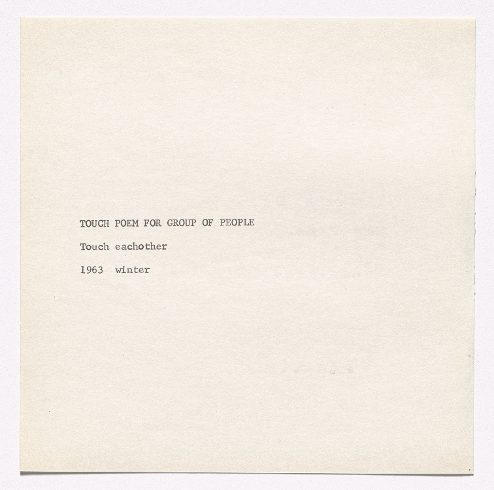
Yoko Ono, Touch Poem, 19633
Yoko Ono is a pioneering Fluxus artist. Many of her pieces employ “event scores,” sets of instructions for the manifestation of the piece. These turn the classical notion of art—as an object of contemplation—on its head and instead force viewers to become participants in the materiality of the piece. They also eliminate the commodity value of art. Touch Poem can never be sold or circulated within the market; it exists solely as an idea and its execution in a particular time and space. This piece inaugurates a series of slippages, of resistance to the traditional norms governing painting on canvas.
Touch Piece, the larger piece from which Touch Poem comes, eventually evolved into Bag in several exhibitions throughout 1964-65, which incorporated a large bag in a dark room. Participants were instructed to strip and enter the bag. When inside, one was deprived of sight and experienced heightening of the remaining four senses. The piece enforced a different kind of sensorial relationship to the work of art, one separate from vision, which has often been seen as its raison d'etre. Within the bag, one becomes sexless, ageless, and raceless; the terms by which we class, categorize, and hierarchize the social evaporate.
Room 1.5: Wolf Vostell, Schwarzes Zimmer (Black Room)
Wolf Vostell, Deutscher Ausblick (German Prospect), de-coll/age object from of the installation Schwarzes Zimmer, organic and industrially produced materials, 1958-9
A continuously flickering screen behind a burnt piece of wood, newspaper cuttings photographing the Soviet Army and the East German police force, barbed wire, crucifix, image of Curial Cardinal Fumasoni-Biondi, bones, two children's toys.
Wolf Vostell, Deutscher Ausblick (German Prospect), de-coll/age object from of the installation Schwarzes Zimmer, organic and industrially produced materials, 1958-94

Curatorial Note: The object contains a continuously flickering screen behind a burnt piece of wood, newspaper cuttings photographing the Soviet Army and the East German police force, barbed wire, crucifix, image of Curial Cardinal Fumasoni-Biondi, bones, two children's toys.

Wolf Vostell, Treblinka, de-coll/age object from of the installation Schwarzes Zimmer, organic and industrially produced materials. Dismantled camera with film negatives, burnt wood. 1958-95
Curatorial Note: the object contains dismantled camera with film negatives, burnt wood.

Wolf Vostell, Auschwitzscheinwerfer 568 (Auschwitz Searchlight 568), de-coll/age object from of the installation Schwarzes Zimmer, organic and industrially produced materials, 1958-96
Curatorial note: the object contains a searchlight with exposed wiring mechanism, mounted on wood. Photograph tucked behind the wire captures a traffic policeman, arm raised, with a whistle in his mouth.
Wolf Vostell was a German artist who was instrumental to the development of Fluxus. Born in 1932 to a Sephardic Jewish mother, he survived the Holocaust thanks to his family’s move to Czechoslovakia. As a young adult, he studied in Paris, where he developed a technique he dubbed “dé-coll/age,” a play on the French word décollage which translates literally to “takeoff” or “to come unstuck.” It is the counterpoise to the collage technique. While collage involves layering individual fragments to create a greater whole, dé-coll/age means removing pieces of an otherwise whole object.
Much of Vostell’s work deals with the negotiation of memories, especially those surrounding the atrocities of the Nazi regime. Schwarzes Zimmer (known in English as the Black Room series) is widely considered his first “environment” and was shown in 1958-9. It consisted of three dé-coll/age assemblages displayed in a black room: Deutscher Ausblick (German Prospect, alt. German View), Auschwitzscheinwerfer 568 (Auschwitz Searchlight 568), and Treblinka. In this work, we see none of the visual documentation of the Holocaust; its memory is totally enshrined in the material objects left behind. The aesthetic of the dé-coll/age technique feels like as much a mirroring of the destruction and violence of the Holocaust itself as it does a rejection of the urge to anesthetize its memorial for public consumption. This piece mirrors the perspective taken in of Vostell’s work throughout his career, contending with Germany’s past through the lens of its present moment.
Room 2: Gutai
The atomic bombings of Hiroshima and Nagasaki were the first time that it became conceivable that human beings could evaporate in an instant. A decade after the bombs dropped, Japan grappled with immense change: occupation by allied forces, increasing globalization, and demilitarization after decades of imperial power. It was in this moment that a group of pragmatic young artists sought to reanimate Japanese artistic culture.
The Gutai Group believed that Japanese artists must sever themselves from the sociopolitical machinations that had long controlled the horizons of Japanese art.
Under imperial rule, art had to support the increasingly militaristic regime. In the absence of such control, Gutai sought to reconnect with what it saw as the essence of Japanese art: the natural world. In pursuit of this goal, they adopted an anti-establishment attitude, creating experimental works that intentionally broke both artistic and social norms.
Though its formation as an organized movement preceded that of Fluxus by a decade, Gutai’s tenets were similar, and its influence, as well as adherents, interacted with Fluxus from the latter movement’s inception.
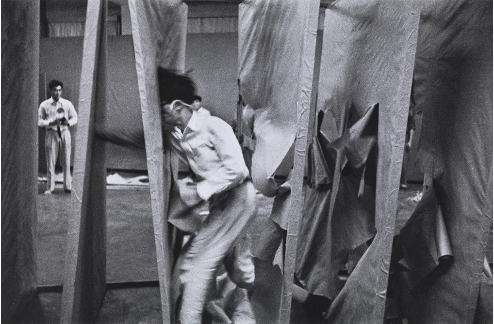
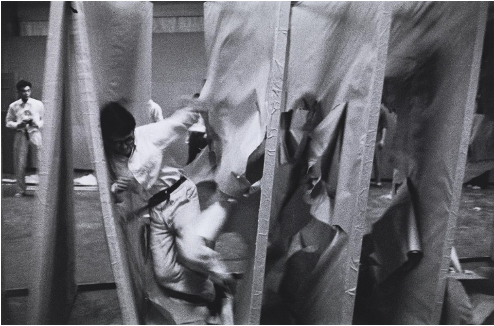
Murakami Saburo, Passing Through, at the Second Gutai Art Exhibition7
Wood and paper, 1956. Curatorial Note: photographic documentation of performance—film courtesy of the artist. Large-scale print.
Performed at the second Gutai Art Exhibition, Murakami Saburo’s Passing Through (also translated as Breaking Through) consisted of a series of stretchers covered in paper that the artist physically broke through, making an explosive sound
At first glance, the piece may seem rather on-the-nose. The stretchers bring to mind canvases, and Murakami’s actions could be seen as a violent, physical rejection of the notion that the two-dimensional canvas is the sole domain of art. Indeed, the piece is partially ideological, a representation of the refusal to abide by the old and polite ways of Japanese art in favor of a new modus operandi.
To a Japanese audience, there would have been a second connotation. The paper panels evoke the room dividers that are an essential part of classical Japanese interiors. Murakami’s action resonated, a kind of breaking through of doorways, a carving of a new physical path through which people might pass, one which eschews the forms that architect tradition.
Shiraga Kazuo, Challenging Mud, at the First and Second Gutai Art Exhibition8
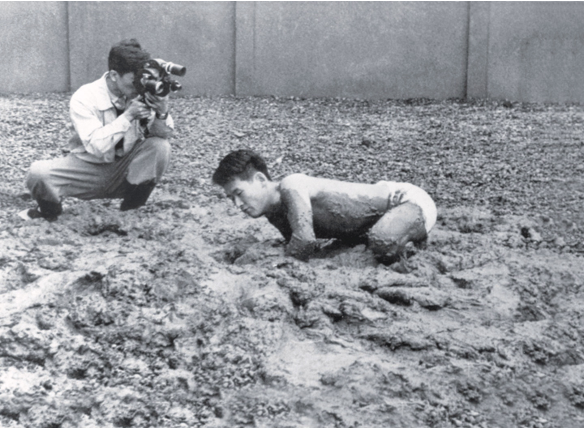
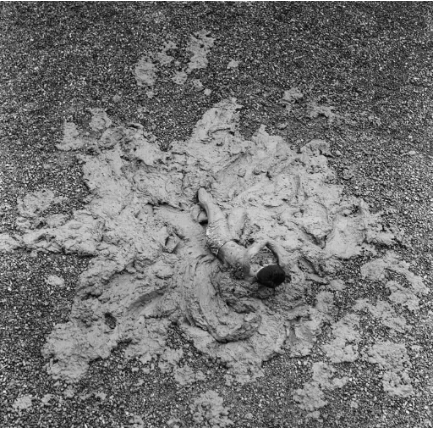
1955-56. Curatorial note: photographic documentation of performance—film courtesy of the artist. Large-scale print.
Shiraga Kazuo’s Challenging Mud emits a kind of subversive violence. It is a performance in which the artist wrestles with a vast pit of mud, at times seeming to triumph over it, and at other moments, appearing trapped in the earth, limbs poking out.
There is a clear invocation of the role of violence in Japanese society. In a traditional sense, the aesthetics of the performance—Shiraga’s outfit, the shape of the pit of mud in a circular ring—bring forth images of sumo, the national sport of Japan. In a sumo fight, each wrestler seeks to force his opponent out of the ring. In Challenging Mud, however, Siraga’s opponent is the earth itself. It can, of course, never be forced out—it is the very material from which the ring is made. The fight is doomed, and yet the artist pursues it with the fervor of a man who believes he can emerge victorious.
The Japanese audience in 1955 came to this performance with the lived experience of a culture shaped by a militarized regime. Challenging Mud speaks to that moment and leaves an impression of the almost comical futility of violence.
Room 3: Stepping Out
Lee Bul, Sorry for suffering—You think I'm a puppy on a picnic? Guerilla performance in Tokyo, 19909
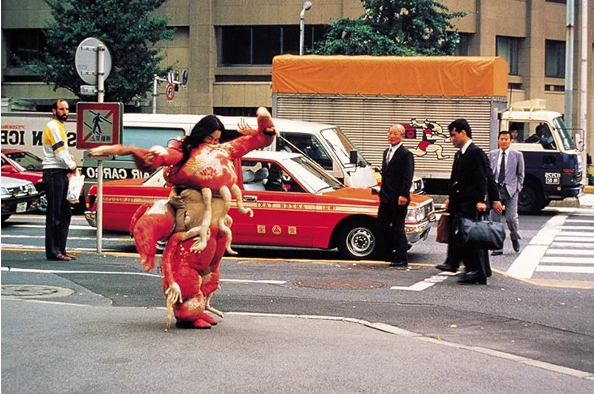
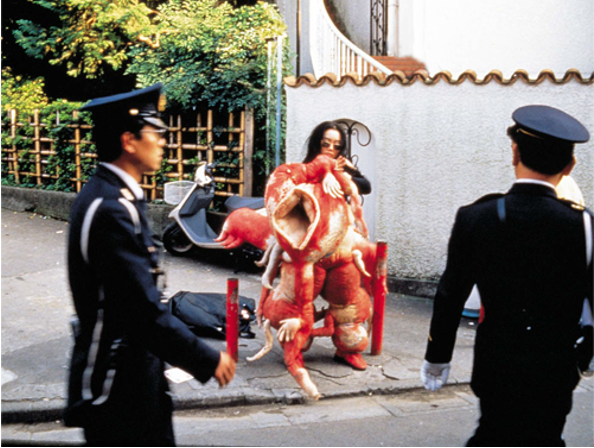
Curatorial Note: Photographic documentation of performance—film courtesy of the artist. Large-scale prints.
Lee Bul’s 1990 performance speaks directly to a history shared by multiple generations of Korean women—one marked by subjugation, systemic sexual violence, and enduring strength.
The history of Korea in the 20th century is fraught. Brutality and forced cultural assimilation were hallmarks of Japanese occupation from 1910-1945. Decades of instability and authoritarian rule followed before the establishment of a civilian government in 1987. Korean women suffered immensely under occupation by the Japanese Imperial Army.
At the time of Lee’s performance, the Japanese government had yet to publicly acknowledge the Japanese Armed Forces system of military sex slaves, known as “comfort women,” who were taken from among the occupied population between 1932 and 1945. During this period, Korean and Chinese women and girls were forced into slavery en masse, becoming prisoners in a system of institutionalized sexual violence.
Over the course of her career, Lee has worked extensively with ‘monstrous bodies’; sculptures of grotesque, amorphous piles of flesh that evoke human and non-human forms. Sorry for suffering—You think I'm a puppy on a picnic? is one of the earliest examples of this throughline in her work.
In a twelve-day guerrilla art action, Lee donned a monstrous body—a multi-limbed, flesh-like sac sculpted from soft silicon—and boarded a plane from Seoul to Tokyo. Once in the Japanese capital, she walked the streets, took the train, visited sites of Japanese imperial history, and entered university campuses—never removing the body.
Lee makes herself a spectacle in a way that spits in the face of the expectation that women be meek, quiet, and submissive. She inserts herself loudly and uncomfortably into the quiet monotony of everyday life for Tokyo-dwellers. Simultaneously, she effaces her own body, rendering it socially unacceptable. The form of the “monstrous body” itself unmistakably references the dehumanization and suffering endured by occupied women under Japanese Imperial rule.
In 1993, Chief Cabinet Secretary Yohei Kono issued a statement acknowledging the Japanese Imperial Army’s creation and administration of “comfort stations.” Despite this landmark statement, Japanese memory politics surrounding sexual violence in occupied territories remains fraught to this day.
Lygia Pape, Divisor (Divider), performed in Rio de Janiero, 196810
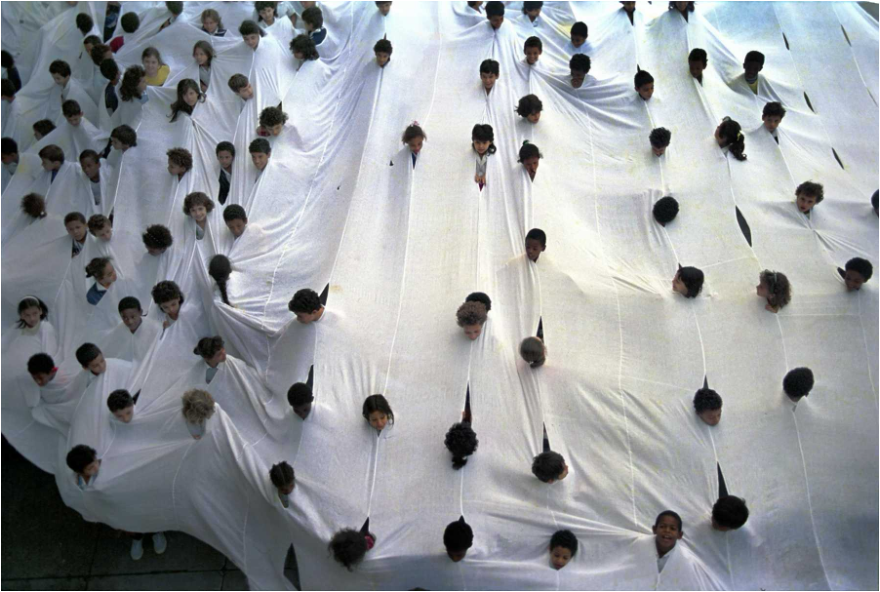
Curatorial note: photographic documentation of performance—film courtesy of the artist. Large-scale print. Seek permission to create miniature museum edition of Divisor, to be used by eight people.
Lygia Pape was a key member of the Brazilian Neo-Concrete Movement of the 60s—a contemporary of (and arguably sister movement to) Fluxus.
Divisor (1968) is composed of an immense white sheet of fabric, suspended between hundreds of walking participants, only their heads visible in the white expanse as they move forward. Divisor, meaning “divider” in Portuguese, is an ironic title: in actuality, the piece is a field of people where commonality supplants difference.
The visible heads of each participant betray their race, gender, and age, but their literal connection in the “body” of Divisor eclipse these differences. As the hundreds of people walk forward, their motion combines into a single, moving force, one entity.
Yet, without each individual participant, the fabric will fall.
Pape shared the first prototypes for Divisor with children who attended school near her studio. They instinctually understood the purpose of the fabric and began to walk as one group. Pape documented this experiment on film, a still from which is included above.
Divisor’s first performance was in 1968, along a busy avenue in the financial district of Rio de Janeiro. In light of the Brazilian dictatorship of the time, this highly visible location was noteworthy; participants (and Pape herself) risked the performance being correctly perceived as an act of defiance and a response to government policy that ran counter to Divisor’s message of commonality among people. For reasons unknown, they were allowed to complete the piece—perhaps an example of Spielraum (“breathing room”).
Doris Salcedo, Atrabiliarios (The Defiant Ones), drywall, shoes, cow bladder, and surgical thread, 199311
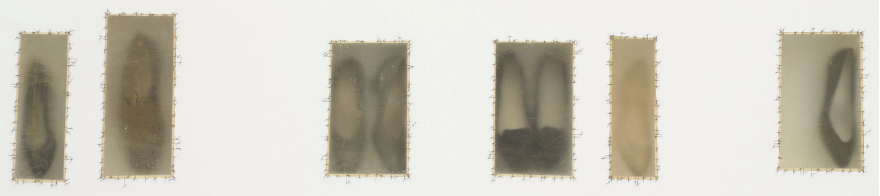
Curatorial note: original objects, encased in wall.
Doris Salcedo is a Colombian artist whose work confronts the nation’s ongoing history of political violence.
For decades, Colombia has been held hostage in a civil war between left-wing guerrilla groups and right-wing paramilitary forces, often with ties to the government. This conflict escalated in scope and brutality when the United States provided military aid and training to the Colombian army, seeking their cooperation in eradicating the narcotics trade. Human rights organizations have since accused the Colombian government of failing to address cartels and actively colluding with right-wing paramilitary groups that do not discriminate between enemy insurgents and civilians. One of the enduring tragedies of the conflict is los desaparecidos—victims of enforced disappearance by all sides, whose fate remains unknown. Among these are an estimated 200,000 women.
In Atrabiliarios (The Defiant Ones), we see the shoes of women who disappeared throughout Colombia’s years of civil war. For the production of the piece, Salcedo visited the families of victims to obtain permission to memorialize their loved ones.
Each woman is represented by a pair of shoes she left behind, encased in an opening built into drywall. A thin layer of animal bladder covers them, creating a hazy, translucent scene, evoking the yellowing of old photographs. The construction of these cases mimics the holy reliquaries common in Catholicism, Colombia’s dominant faith.
Surgical thread, painstakingly tied off in a manner similar to how one closes wounds, ties the bladder to the face of the wall. When an incision heals on the human body, the stitches used to close it are either removed or naturally dissolve. In Atrabiliarios, we see each stitch deliberately left for the viewer to see. The loss of these women is a wound that has not healed.
Room 3.5: Vaporización
Teresa Margolles, Vaporización, Installation at the MOMA P.S. 1 exhibition “Mexico City: An Exhibition about the Exchange Rates of Bodies and Values” in New York, 2002, in other locations 2001-201812
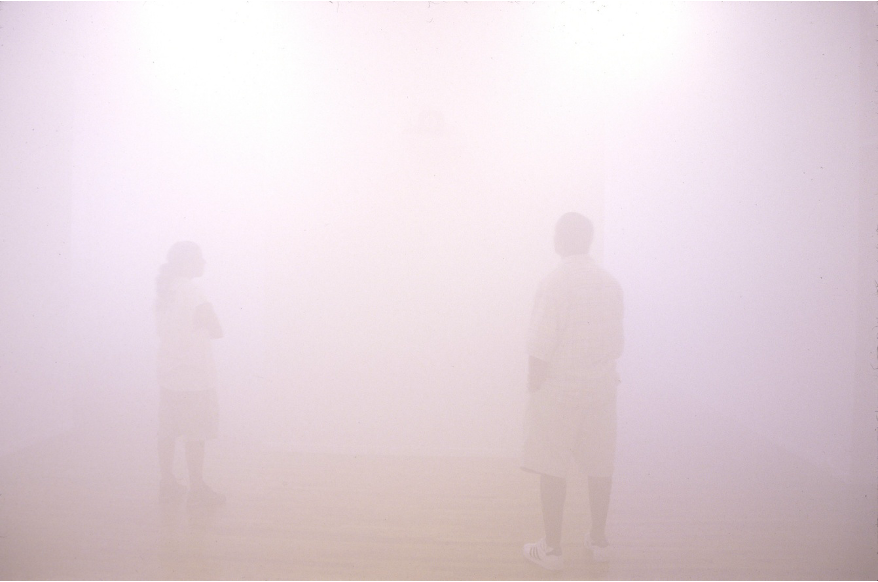
Curatorial note: Full-room installation; photographs above serve as reference
Teresa Margolles is a Mexican artist whose work frequently speaks to grief, violence, and society’s relationship with death. She often uses forensic materials that she encountered in her personal history as a mortician in Mexico City in the early 1990s, during a peak in violent crime in the country. Of particular focus in her work are underserved and socially isolated victims of brutality.
In Vaporización, Margolles fills a room with morgue water used to wash the corpses of those who died anonymously in the streets of Mexico City.
Immediately one is struck by the dichotomy between the deeply unsettling and the deeply beautiful in this piece. The fog created by vaporized liquid creates a sense of ephemerality, of the slow disappearance of the soul into memory. Simultaneously, there is a kind of coercion at play. Audiences are not aware of the water’s origins when entering the room.
Humans often treat the death of others as something removed from themselves. Here, Margolles has viewers literally breathe in the artifacts of the deceased, directly implicating them in the reality of death and refusing to allow distance from others’ fates.
Room 4: New York
Carolee Schneemann, Viet Flakes, 85mm film toned black-and-white, sound collage by James Tenney, 1962-6713

Curatorial Note: film to be shown in dark room.
The Carolee Schneemann Foundation describes Viet Flakes as an “obsessive collection of Vietnam atrocity images, compiled over five years from foreign magazines and newspapers”. Schneemann’s work is intentionally provocative and rooted in social commentary, often combining performance with media. Viet Flakes was featured as part of her 1967 performance piece Snows, which was created in protest against the Vietnam War.
Viet Flakes’ soundtrack, composed by James Tenney, features Vietnamese traditional chants, Western classical music, and 1960s popular music. Some of these include We Can Work It Out (the Beatles, 1965), What the World Needs Now Is Love (Jackie DeShannon, 1965), Jesu, der du meine Seele, BWV 78 (Bach, 1724), and Piano Concerto No. 20 (Mozart, 1785). The juxtaposition of upbeat Western music— despite the anti-war lyrics of several of the selected works—with imagery of suffering creates disorientation and a sense of visual and auditory whiplash. The audience is continually exposed to disparate fragments of the Western home front and Vietnam. It becomes clear that there is a difference in the reality of the former, who cry outrage over war, and the latter, who must live through it.
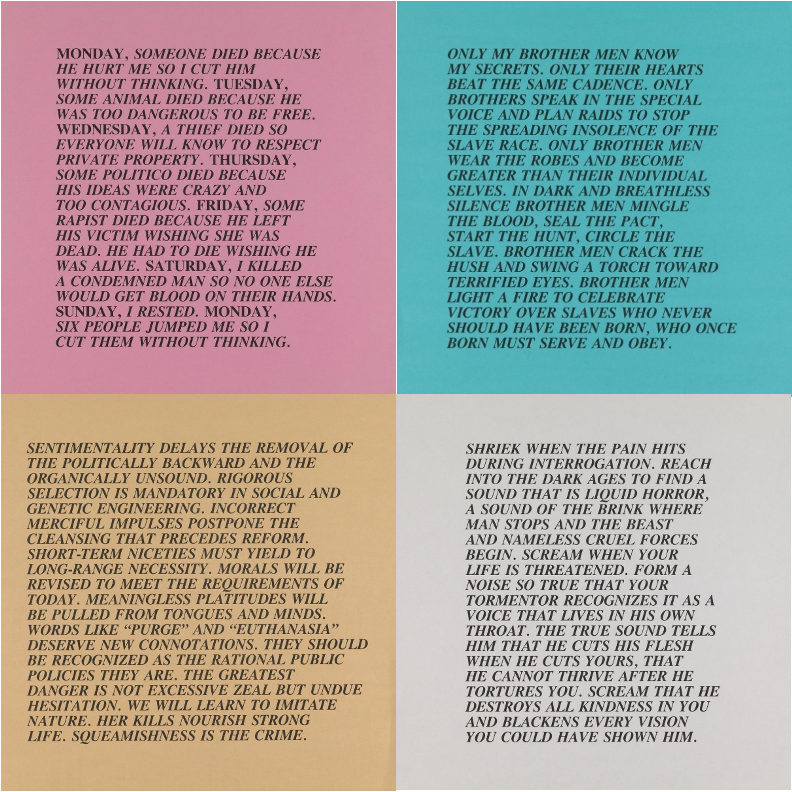
Jenny Holzer, selections from Inflammatory Essays, 1979–82, lithograph on paper14
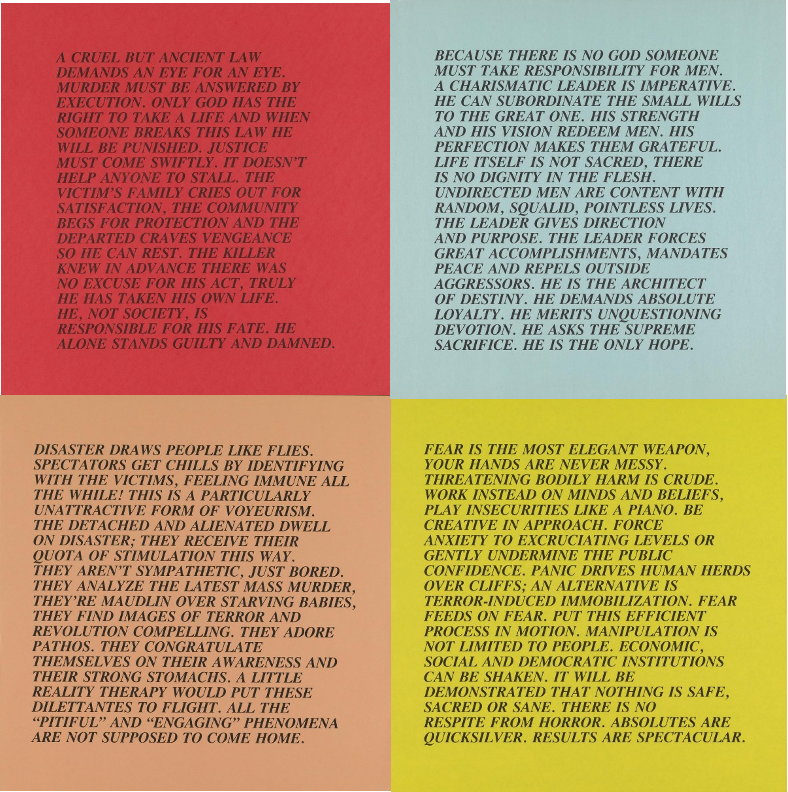
Curatorial note: reprint of essays on rice paper, displayed in grid covering wall from floor to ceiling
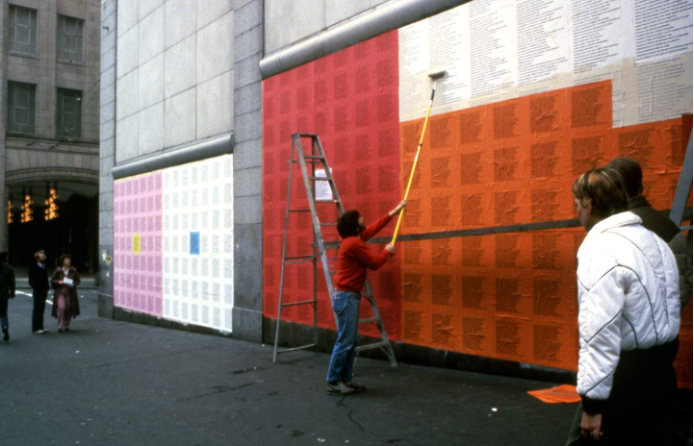
Jenny Holzer, from Truisms, 1977–79; Inflammatory Essays, 1979–82, installation at Poster Project in Seattle, 198415
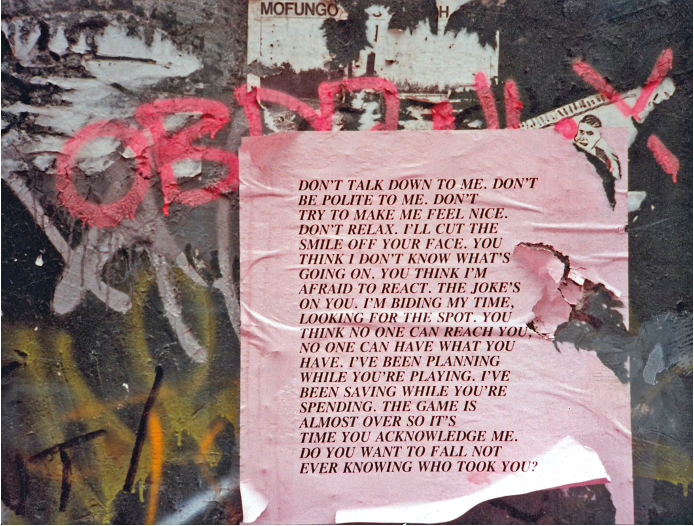
Jenny Holzer, from Inflammatory Essays, 1979–82, installed in New York City, 198316
Jenny Holzer’s Inflammatory Essays speak for themselves.
The short essays have taken many mass-produced forms since they were originally wheat-pasted anonymously on the streets of New York City. The selections shown here are merely a few of a large collection that deal with themes like power, consumption, greed, sex, violence, and the nature of societies. Taken as a whole, they are intellectually inconsistent and often contradictory, but they are not meant to form a coherent ideology. It is difficult to discern the narrator(s) of these pieces. They spill forth from anonymity as if the voice of some kind of omniscient deity—sometimes angry, sometimes humorous, often holding a mirror to the darkest impulses of humanity.
Exhibition End
Emma Van Zandt was a 2025 FASPE Business Fellow. She is currently a digital strategist at West Elm.
Notes
1. George Maciunas. Fluxus Manifesto. 1963 | MoMA. Licensing: https://www.artres.com/CS.aspx?VP3=DamView&VBID=2UN94S25LR4ZT&SMLS=1&RW=1728&RH=865&FR_=1&W=2560&H=1271.
2. Video cassette, VHS edited by Harlekin Art, Wiesbaden, 1992 and DVD copy. Fluxus Festival neueste Musik, Wiesbaden, a production of ECG Frankfurt, 1962.
3. Yoko Ono. Touch Poem for Group of People. 1963. Published in Grapefruit (Tokyo: Wunternaum Press, 1964), n.p. Offset, page: 5 7/16 × 5 7/16″ (13.8 × 13.8 cm). The Museum of Modern Art Library, New York. © Yoko Ono 2015. https://www.on-curating.org/issue-51-reader/yoko-onos-touch-piece-a-work-in-multiple-media-19602009.html.
4. https://sammlung-online.berlinischegalerie.de/en/collection/item/142454/.
5. https://sammlung-online.berlinischegalerie.de/en/collection/item/181052/.
6. https://sammlung-online.berlinischegalerie.de/en/collection/item/181053/.
7. https://www.tat e.org.uk/art/art works/otsujimurakamisaburopassingthrough-2ndgutai-artexhibitionp82294. Licensing: https://www.tateimages.com/preview.asp? image=P82294.
8. Shiraga Kazuo, Challenging Mud (Doro ni idomu), 1955; (2nd execution) © Shiraga Fujiko and Hisao and the former members of the Gutai Art Association. https://smarthistory.org/shiraga-kazuo-challenging-mud/.
9. Lee Bul (South Korean, b. 1964). Sorry for suffering—You think I’m a puppy on a picnic?, 1990. 12-day performance, Gimpo Airport, Narita Airport, Downtown Tokyo, Tokiwaza Theater, Tokyo. © Lee Bul. https://www.metmuseum.org/perspectives/escape-artist.
10. https://www.wikiart.org/en/ly gia-pape/divider-1968.
11. https://www.moma.org/collection/works/134303?#installation-images. Licensing: https://www.artres.com/CS.aspx?VP3=DamView&VBID=2UN94S25B5DB7&SMLS=1&RW=1728&RH=865&FR_=1&W=2560&H=1271.
12. https://www.moma.org/calendar/exhibitions/4766/installation_images/42554. Licensing: https://www.artres.com/CS.aspx?VP3=DamView&VBID=2UN94S25B5I24&SMLS=1&RW=1728&RH=865.
13. https://www.dailymotion.com/video/x59m4ac. For the quote below: https://www.schneemannfoundation.org/artworks/viet-flakes. Viet-Flakes | Carolee Schneemann Foundation.” Schneemannfoundation.org, 2016, www.schneemannfoundation.org/artworks/viet-flakes. Accessed 4 Feb. 2026.
14. Jenny Holzer, Inflammatory Essays I (detail), 1982. © Jenny Holzer / Artists Rights Society (ARS), New York. Licensing: https://www.tate.org.uk/art/artworks/holzer-inflammatory-essays-65434.
15. Poster Project, Seattle, Washington, USA, 1984, © 1984 Jenny Holzer, member Artists Rights Society (ARS), NY.
16. Jenny Holzer, from Inflammatory Essays, 1979–82, installed in New York, 1983. © 1983 Jenny Holzer, Artists Rights Society (ARS), New York.