

Journalism Program
I learned more about journalistic ethics in the 12 days that I spent in New York, Germany and Poland with my fellow FASPEans than I have in the past year of journalism school.
Samantha Pickette
2014 FASPE Journalism Fellow
FASPE is an intensive, two-week study program in professional ethics and ethical leadership. FASPE is neither a Holocaust studies course, nor a genocide prevention program. Rather, the curriculum is designed to challenge Fellows to critically examine constructs, current developments and issues that raise ethical concerns in their professions in contemporary settings in which they work.
FASPE Journalism Fellows examine the motivations and conduct of German and international journalists in promoting or misreporting Nazi policies. FASPE then draws on these historical examples to help Journalism Fellows grasp their role and responsibility as individuals with influence in their communities; and to encourage them to identify and confront the ethical issues currently facing journalists and media institutions at large.
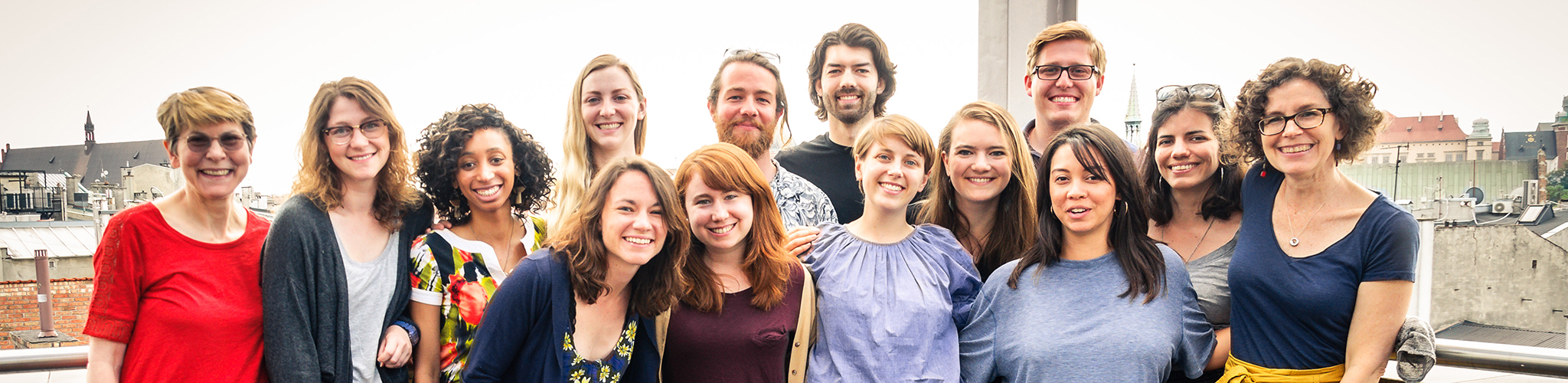
Each year, FASPE Journalism awards fellowships to 13 to 16 journalism students and early-career journalists. Fellows spend two weeks in Berlin and Poland, where they visit key sites of Nazi history and participate in daily seminars led by specialized faculty. The program couples the power of place with academic rigor and many informal opportunities for creative exchange.
FASPE draws on a large pool of applicants, whose diverse backgrounds and interests enrich discussions both inside and outside the seminar room. Journalism Fellows travel with Medical and Clergy Fellows, allowing them to broaden their understanding of the role of professionals over shared meals and activities and in several interdisciplinary seminars. FASPE Fellowships are fully funded so that financial ability does not affect participation.
Eligibility Guidelines
FASPE seeks Journalism applicants who fit into one of the following three categories: 1) have some journalistic experience (whether in a college newsroom or otherwise) and are enrolled in a graduate program of any kind and planning to work as a journalist; OR 2) have completed an undergraduate degree and are working as a journalist; OR 3) have completed a graduate degree and are working as a journalist.
Preference will be given to candidates who have journalistic work that has been published or aired by a recognized news organization.
FASPE seeks Journalism Fellows who are preparing for or in early stages of their career, with total professional experience generally not exceeding 10 years.
DATES FOR THE 2027 JOURNALISM PROGRAM: June 18, 2027 - July 2, 2027
Click here to receive information and updates about the 2027 Fellowship programs.
To view photos of the 2026 Journalism program and read about the experience, please go here.
FASPE Journalism Fellows examine topics such as:
- the complicity of German and foreign journalists in Nazi policies through inadequate coverage or outright misrepresentation of the crimes being committed
- the impact of technology on journalism
- the role of journalists in electoral politics and in holding power accountable
- the nature and propriety of advocacy journalism
- normalizing aberrant behavior through media coverage
- the challenge of reporting in an era in which fake news and accusations of “fake news” are common
- balancing the costs and benefits of access tactics to address ethical issues within the journalism community or media outlets
 Newsstand in the Free City of Danzig, 1937.Swiss National Library / Annemarie Schwarzenbach / SLA-Schwarzenbach-A-5-13/060
FASPE Journalism Fellows now work as editors, reporters, nonfiction writers, photojournalists, broadcasters and other professionals, across a wide range of media. Through their shared FASPE experience, Fellows form long-lasting relationships and deep bonds that grow over time. Journalism Fellows participate in formal and informal networks that provide support throughout their careers.
FASPE Journalism was initially developed in consultation with faculty at Columbia Journalism School.