


The Garden
by Lulu Chen, 2025 Medical Fellow
Mixed media—acrylic and paper on a plastic mirror
The mirror forces the viewer to see their reflection. No one is exempt—those who wish to observe, to get close, must be comfortable seeing themselves within the art itself. Studying the ethics of professionalism through FASPE is the same.
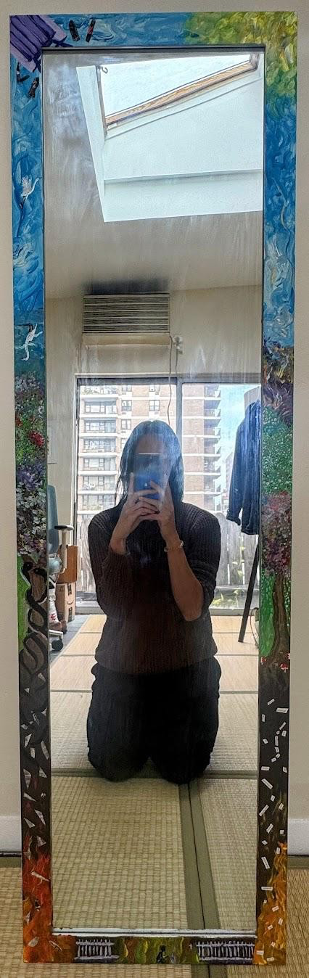
Based on Hieronymous Bosch’s Garden of Earthly Delights, these three panels are to be read from bottom to top. The unclear demarcations between panels represent the concept of Spielraum, or “wiggle room,” and it is ambiguous whether the panels represent heaven, earth, and hell as one might initially presume.
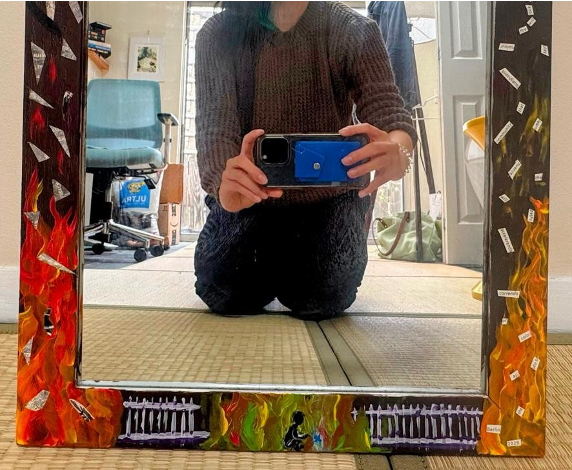
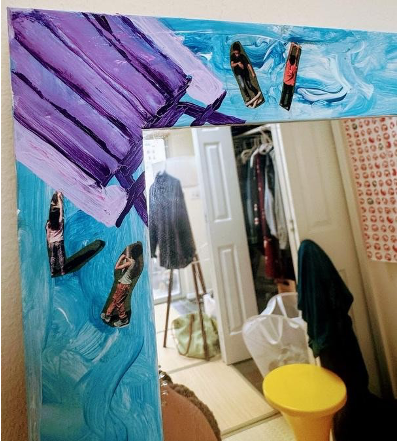
Bottom panel: This panel is the most literal, representing how logic and rationalization can lead us astray through the manipulation of moral interpretations. The three fires derive from a Buddhist metaphor and are connected by a railroad. The train tracks, with their third rail, represent the use of technology and human industry to advance our means for both good and evil, including weapons of mass killing and destruction.
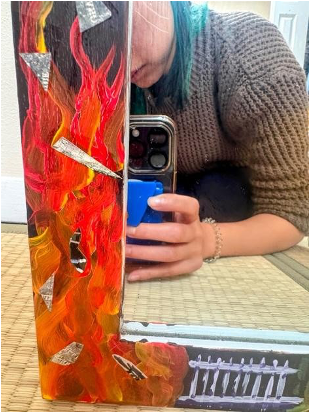
Bottom left: This fire represents anger or hatred, the motivation behind many killings. The tombstones memorialize those lost; there are also shoes, disconnected from their bodies but connected to their shadows. This represents the experience of walking through Auschwitz, seeing piles upon piles of hair, suitcases, eyeglasses, and shoes. They are only objects but their shadows, their ghosts, subsist. They were once connected to bodies.
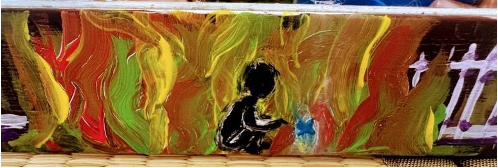
Bottom middle: This fire represents delusion or ignorance. Our logical rationalizations (see right-fire) and our emotional hatred (see left-fire) both contribute to our ability to delude ourselves into thinking that we are doing the right thing. The neglected child from Ursula K. Le Guin’s “The Ones Who Walk Away from Omelas,” included here, represents the willful ignorance that we believe will preserve our paradise. The child observes a butterfly, colored blue to represent hope from the top panel.
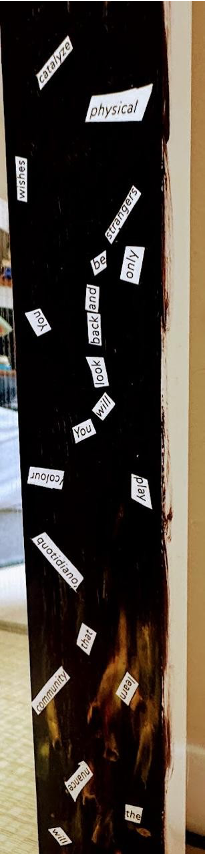
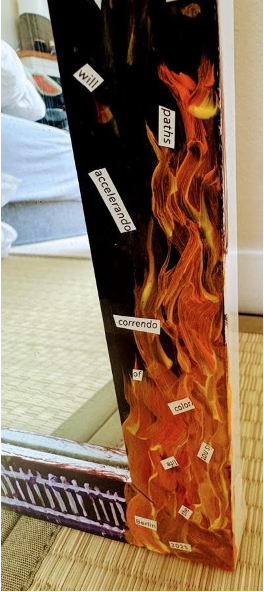
Bottom right: This fire represents desire or greed, as well as the use of logical rationalizations to justify that desire or greed. The panel depicts the 1933 book burning by Nazi university students. By burning or banning literature, scholars put forward one ideology at the expense of other perspectives and help to create conditions for tyranny. The words also represent our desire to hide behind research papers on the path towards doing nothing. We use words to rationalize, to hide our greedy motives behind loftier goals. Among the words and phrases rising from the flames are “nuance,” “quotidiano,” and “you will look back and be (only) strangers.” The last of these is a nod to how quickly we become strangers to remembering.

Middle: This panel’s impressionistic bent implores us to understand our emotions when it comes to ethics, as well as to turn towards the natural world. In the Christian religion, God places these two trees in the Garden of Eden—to give human beings choice, agency to choose between right and wrong. In retrospect it seems easy to choose, but from the prospective view it is not always clear which tree is to be trusted.
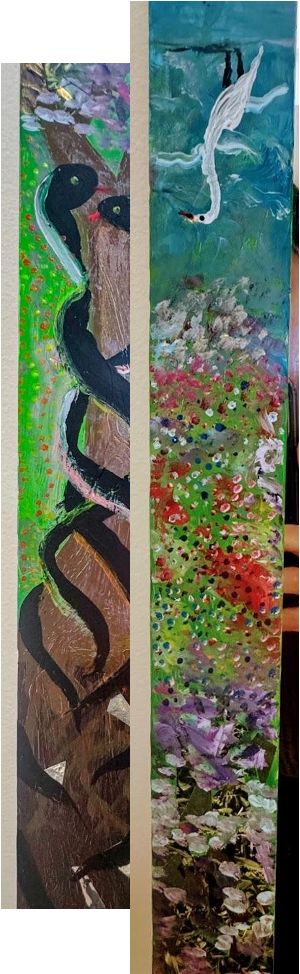
Middle left: While the medical profession is represented by the Rod of Asclepius (a staff with one snake), the symbol is often mistaken for the Caduceus (a winged staff with two snakes), a symbol of commerce and negotiation. Here the two blur together. The two snakes wrapped around the tree represent the devolution of the medical profession from a practice of healing into a commercial entity with compromised interests. At the top of this panel, the water in which a crane stands, is inspired by Claude Monet’s Bord de Mer, which was confiscated from a Jewish family in 1940. The crane stands in a reflection of the skies.
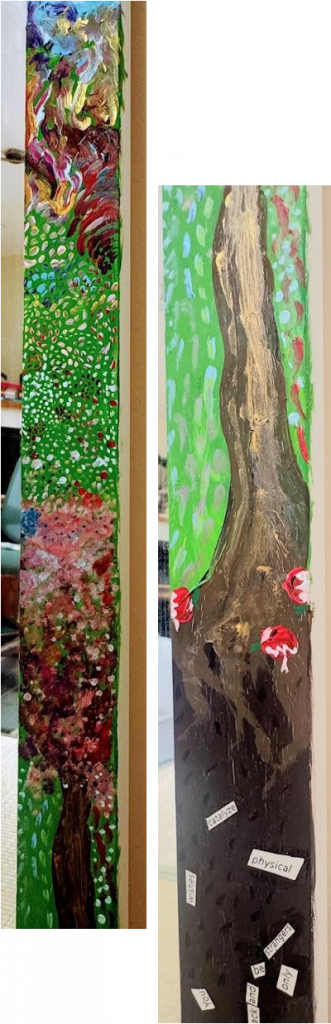
Middle right: This tree is safe from snakes but stands beside fallen apples. The apples have teeth so that they may eat. A symbol of the Tree of the Knowledge of Good and Evil, the apple shows how knowledge (and institutions of education and prestige) can be cultivated in dangerous ways. University graduates and highly educated professionals were disproportionately recruited to the Schutzstaffel (SS), and in Himmler’s October 1943 speech to the SS, his use of the bacillus as a metaphor testifies to his skillful use of language. Himmler depicts the targets of the Nazi Party as a bacillus, a blight upon society, to be extinguished for fear of infection. This panel reclaims the metaphor by depicting the bacillus as an essential decomposer of tree matter. The bacilli are the masses of workers who support society and are necessary for the functioning of a healthy ecosystem.

Top: Fairly sparse and open, this panel is the most ambiguous and may represent some form of healing, hope, or a path forward.

Top left: The flying crane represents peace and healing. The picnic table, which contains the same purple hues as the railroad, represents a different use of the same material (wood). At the Brandenburg Euthanasia Centre, a propaganda video provided rationalizations for killing nearly 10,000 disabled patients, showing people with disabilities eating lunch on a picnic table on a sunny day. The voice-over narration stressed how they were a burden on the rest of society and therefore unworthy of life. Yet in the video, we can see smiles on the patients’ faces. With other eyes, we might feel glad that our finances and efforts go towards supporting people with disabilities, who deserve our care. The discrepancy between the ominous voice-over and the smiles in the video shows how easily we can wander, seeing the care for our patients as a burden rather than a joy. The children placed by the picnic benches serve as a memorial to the children who lost their lives in the concentration camps. In Michal Rovner’s permanent exhibition “Traces of Life,” the artist copies fragments of children’s sketches during the Holocaust onto the walls of a room in Block 27 of Auschwitz-Birkenau. Their drawings are remembered, but the children deserved so much more: to play, to dance, to grow up.
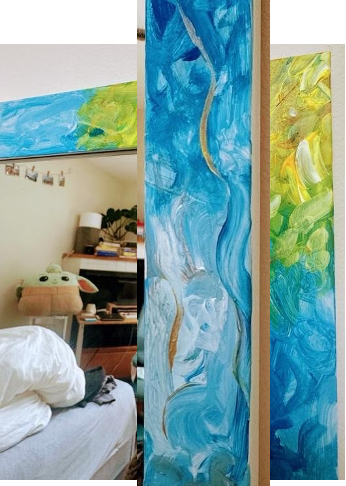
Top right: This panel is based on “What I Would Give,” a poem shared during our first FASPE Medical session. The premise is simple: what I want to give to my patients is not simply pills or other medications but sunshine. My clinic is a basement, and my patients keep wanting to see me in the dungeon. They ask for more medications, more appointments, more, more, more, but I wonder if it would do them more good to send them out of my office and have them sit in Central Park, to touch grass and feel the warmth of the sun on their faces. No dosage of antidepressant can change the atrocities of the world; no amount of antipsychotic can erase the stigma, fear, and isolation. This is my wish: that rather than help them cope in a world that they don’t want to live in, that we might create a world that they want to live in.
Yanglu Chen was a 2025 FASPE Medical Fellow. She is a psychiatry resident at Mount Sinai Hospital.