


An Annex on Being
by Maggie Wang, 2025 Law Fellow
Excerpts from the Living
And I can think only about the starry sky
About the high mounds of termites.
—Czesław Miłosz, “Not More”1
My views on freedom are
heavy, but the forward motion of ice
is enough to carry them.
From a distance I receive
the guttural echo.
In the same way poets
write brief histories, I know
when it is over. I could bear right to begin
again, but after such barren ground,
I am reluctant of letting go.
Some compare fear to the sea
rising higher. Others to a forest after
clear cutting. As for me, I am content
without metaphors.
Night awaits me gently from its sky-perch.
I was not referring to any freedom
in particular.
Strictly Speaking
[T]o witness is also to participate in the world in its relational becoming.
—Deborah Bird Rose and Thom van Dooren, “Encountering a More-Than-Human World: Ethos and the Arts of Witness”2
I am not concerned about memory. Not only. Not that
you would ever accuse me. Among other things,
I confess to not knowing a basis for my being.
Nothing could be simpler than the way water
leaches through the body, and the body through
the ground wherein it is buried. Memory acts
on us—an apparition. Pure reason to obfuscate
its existing. Question the soil about its composition:
silt or sorrow, worm tied up in wonder at the works
of man. A shovel to cover stark clay. I will come early
for an audience. Trees hold their rings. One seedling
grows backwards at the horror. A brief in opposition.
A fear of the week, the month, the year. Seeing is not
a sense of obligation. A single day is enough to obliterate.
Do not keep to your side of the line. Such is not living.
Sometime later, after fog, you may feel a sense
of a trapping. Long verse and veneration. Still stand
and sameness converging in the plural. Every return
sparks a measure of controversy. The trowel weeps
at the set-aside remedy. The birches keep their library
and archive. We may borrow from it with permission.
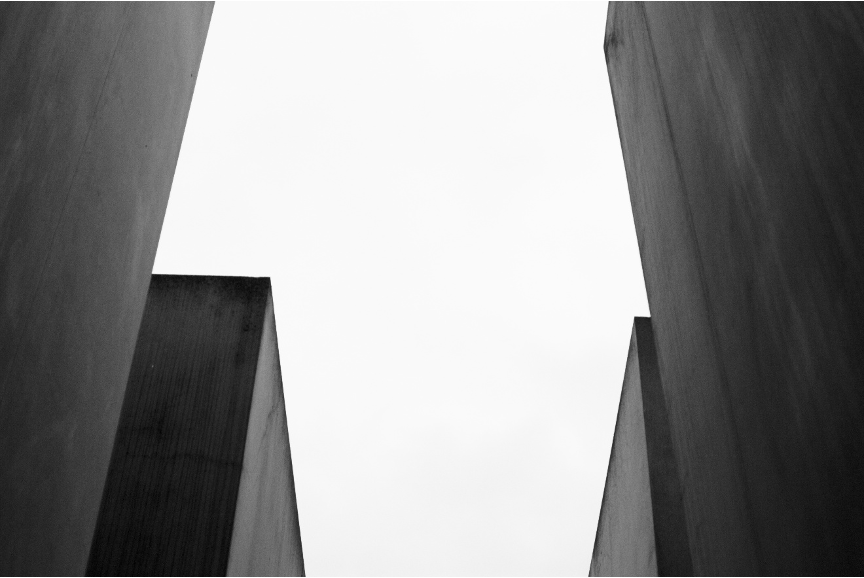
Hereinafter3
My life is the gardener of my body.
—Yehuda Amichai tr. Chana Bloch, “I Wasn’t One of the Six Million: And What Is My Life Span? Open Closed Open”4
I will refer to it fragment upon fragment:
long yellow on the diagonal, a theorem about late arrival,
shorthand for a being in danger.
A condition of remembering: that the wound be properly dressed.
Surgeon clutches microscope and magnifying glass.
Scalpel retreats to its resting place.
In the epilogue, we hardly recognize the body.
Mind rations its hunger.
Organs give way to the metronome.
Skin contours the borders of its census-designated place.
What little remains of us after:
a sense of timid passing, a stumbling river.
No moment is given to obliteration.
Make room to rest your fear and anger.
Finally, leave space for light to enter:
a column or confession, a sketch for post-processing,
parenthetical existence that suffices for certainty.
Every stone, leaf, stick, and grain of sand will be built of your memory.
Maggie Wang was a 2025 FASPE Law Fellow. They practice law in Washington, D.C.
Notes
1. Miłosz, Czesław, “Not More,” https://modernpoetryintranslation.com/poem/not-more/. All images are the author’s.
2. Quoted in Małczyński, Jacek, “The Politics of Nature at the Former Auschwitz-Birkenau Concentration Camp,” Journal of Genocide Research 22:2, (2020), pp. 197-219.
3. Poem previously published in RockPaperPoem, https://rockpaperpoem.com/poem/hereinafter/.
4. Amichai, Yehuda, “I Wasn’t One of the Six Million: And What is My Life Span? Open Closed Open” from Open Closed Open, trans. by Chana Bloch and Chana Kronfeld, published by Harcourt.