


On Authenticity and Staging
by Tanja R. Helmert, 2025 Clergy & Religious Leaders Fellow
The house our cohort stood in front of was gray, rectangular, and inconspicuous. A narrow path led to the stairs, which ascended to a wooden door. To the left, the roofs of uniform buildings rose behind a wall topped with barbed wire; to the right was an overgrown garden. During the war, this was the house where Rudolf Höß, commander of Auschwitz, and his family lived. Knowing who once resided here should feel unsettling, but the house was calm and empty, ordinarily so.
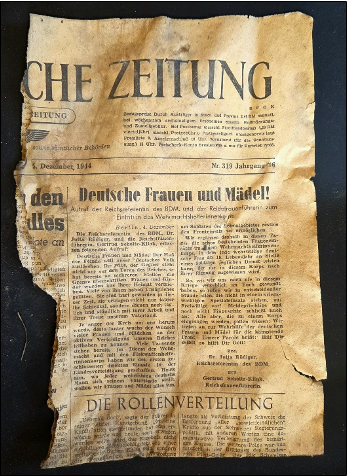
Inside, the house resembled a construction site, it was dusty and undergoing renovation. A few information signs hung on the walls, and in one of the center rooms was a display case with several items including a 1944 German newspaper article, a pair of striped pajama pants, and a stamp with Hitler’s profile. I caught myself instinctively searching room after room for traces of the house’s Nazi past. I had the urge to find something that would feel authentic1 inside this non-curated, former Nazi-owned house, a building which sits just at the edge of the large and widely visited “Auschwitz Memorial and Museum.”
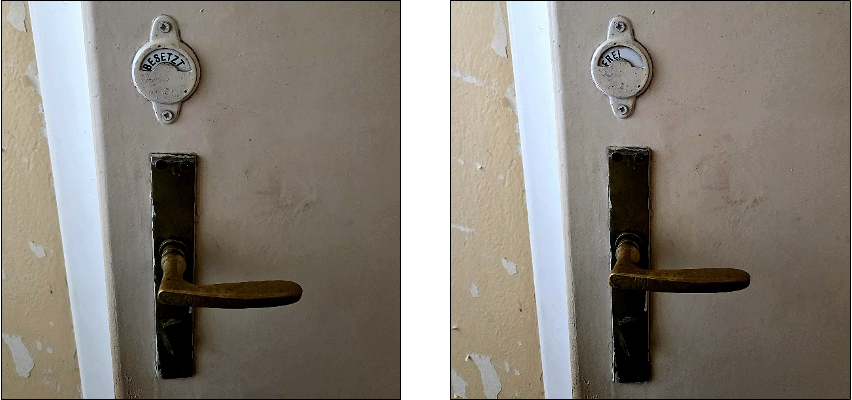
In an upstairs room, I came across another newspaper sitting beneath torn wallpaper, clearly used as a base for the plaster. I was excited, but on closer inspection, its year read “1993.” Disappointed, I walked into the next room, and as I entered, I noticed a small nook in the back corner that looked like it had at one time contained a built-in cupboard. The carpet was the only thing left in the nook, and I wondered if its design was perhaps popular during the Nazi period, or if carpet material could even last so long. Having found no clear answers to my curiosities or anything identifiable from the Höß family, I went back downstairs and walked past a seemingly insignificant object by the first-floor restroom that caused me to do a double-take: the toilet lock. Its brass latch was connected to an indicator with the words “free” and “occupied,” written in German. While it was a remnant of everyday life, discovering it felt like a small triumph. I got what I was hoping for.
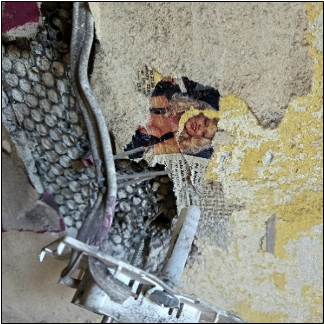
In the basement of the house, we came across a blocked tunnel that I remembered from The Zone of Interest (2023).2 In the movie, Rudolf Höß is depicted walking down the very same pathway, which connected his villa to the camp commandant’s office.3 The neighboring basement room contained metal struts protruding from the back wall. Thinking of scenes from the film at the nearby riverbank, I wondered if this was where the Hößs’ hung their paddle boats.4
Possible images of their everyday life flooded my mind, and the house suddenly felt gloomy. The reality of the Höß family’s actual presence there sank in, and I felt relief when we left the house and walked out into the warm sunlight.
***
After our visit to the Höß-Villa, we walked to the main entrance of the Auschwitz memorial. We spent time entering and walking past the prisoners’ barracks and gallows and sat beside the site where mass shootings frequently took place. The following day, we visited the vast grounds of Birkenau, and I was disturbed by its immense size. No words can describe the incomprehensible machinery of the Auschwitz-Birkenau camps. Knowing what happened there continues to leave me speechless.
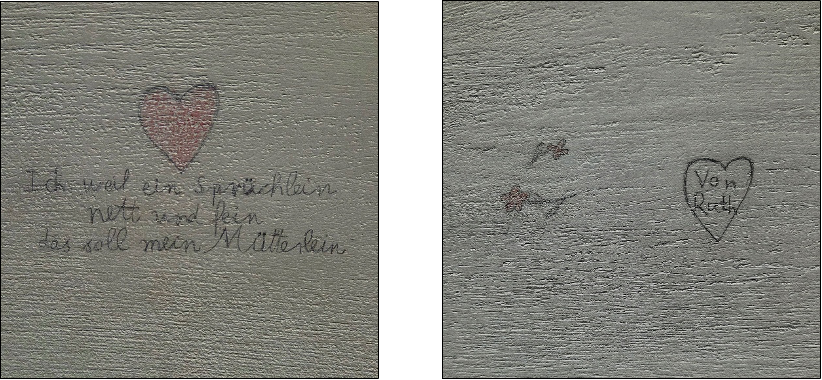
Auschwitz-Birkenau is a place where people seek an experience, not just information. Millions come here not only to learn but to participate, to form their own impressions, and, in a sense, feel history. One of the Auschwitz barracks contains an exhibition where drawings from children held captive there are recreated on the wall. Standing in that room, I realized how little in that place is left to chance: the barracks are curated and staged as exhibitions. Fighting against decay, the memorial constantly restores and repairs remnants of what is still there based on what once was—from stones and wood to clothing and images. In the attempt to preserve memory for future generations, Auschwitz-Birkenau becomes a site of historical performance.5
Unrelenting deterioration of memorial sites will require ever-increasing preservation efforts to sustain remembrance of their significance and their ethical weight. This work is not incidental; it reflects the fact that the power we ascribe to such physical places rests on collective memory and the meanings we continually invest in them.6 In this sense, Auschwitz-Birkenau must keep “performing” itself—restoring, curating, and presenting—so that its lessons remain visible and binding for future generations. The memorial actively resists the erasures of time, exerting considerable energy to put a forceful stop to the decay that threatens to diminish its role as a witness to history of humankind’s horrors.
In both the Höß-Villa and the Auschwitz-Birkenau memorial, I found myself searching for an authentic encounter with history. The villa, with its lack of curation, allowed me to have an individual exploration that was fascinating and fun but didn’t prompt ethical engagement. By contrast, the memorial’s careful interpretation—its ongoing work of staging, preserving, and performing the past—inspired deeper reflection. There, I was drawn not only to question the horrors of history but also my own role in current injustices. The site’s intentionality does more than preserve memory; I experienced it calling visitors to carry its lessons forward into the responsibilities of today.
***
If memorial preservation stages memory to sustain ethical reflection across generations, then liturgy too can be understood as a form of performance, one that seeks to move communities beyond mere observation into action. I am reminded of the sermon delivered by Episcopal bishop Mariann Edgar Budde during the service for President Donald Trump’s second inauguration at the National Cathedral in Washington, D.C. She made a direct appeal to the president:
Let me make one final plea, Mr. President. Millions have put their trust in you. As you told the nation yesterday, you have felt the providential hand of a loving God. In the name of our God, I ask you to have mercy upon the people in our country who are scared now. There are transgender children in both Republican and Democratic families who fear for their lives.
And the people who pick our crops and clean our office buildings; who labor in our poultry farms and meat-packing plants; who wash the dishes after we eat in restaurants and work the night shift in hospitals – they may not be citizens or have the proper documentation, but the vast majority of immigrants are not criminals. They pay taxes, and are good neighbors. They are faithful members of our churches, mosques and synagogues, gurdwara, and temples.
Have mercy, Mr. President, on those in our communities whose children fear that their parents will be taken away. Help those who are fleeing war zones and persecution in their own lands to find compassion and welcome here. Our God teaches us that we are to be merciful to the stranger, for we were once strangers in this land.7
This inauguration service was, without a doubt, carefully scripted from start to finish. Sermons are always performative. And yet, Bishop Budde’s appeal is undeniably powerful, even authentic. Here, authenticity does not arise from spontaneity but from her willingness to leverage institutional authority in the face of injustice. Instead of dwelling on abstractions, she calls for the protection of those most vulnerable, and, in doing so, risks personal and professional consequences for her words. What makes her performance authentic is this calculated willingness to take risks to counter division, not the absence of staging.8
Ministers are called to use performance deliberately and responsibly. The ongoing question in our attempt to do so is: does our liturgy serve to create community and call us to stand for justice? The challenge is not to be “unstaged” but to stage consciously, and in the service of truth, healing, and the common good.
I am left exploring the comparison between memorial preservation and worship. At its best, memorial preservation performs not for individual curiosity but for communal education. Only through shared commitment to remembrance does a place like Auschwitz-Birkenau maintain the public support necessary to continue its educational mission. Similarly, the church is a communal space that serves to bring people together, heal, and educate, relying on community support to continue to exist and influence. Both spaces channel collective energy toward something greater than individual purposes.9 My hope is that in a hundred years communities will still have such spaces to gather—whether memorials or churches—to confront the injustices of the past and be inspired to challenge the injustices of their own time.
Tanja R. Helmert was a 2025 FASPE Clergy & Religious Leader Fellow. She serves as a vicar at Trinity Evangelical Lutheran Church in Santa Barbara, California.
Notes
1. All images are the author’s. By authentic, I don’t mean an untouched, pure truth but rather the impression of immediacy–the feeling of encountering a place or a story in its originality, without filters. This draws on Walter Benjamin’s concept that “the presence of the original is the prerequisite to the concept of authenticity”; see Benjamin, “The Work of Art in the Age of Mechanical Reproduction,” in Illuminations, trans. Harry Zohn, ed. Hannah Arendt (New York: Schocken Books, 1968), 220.
2. The Zone of Interest, directed by Jonathan Glazer (A24, 2023).
3. The Zone of Interest, 1:00:17–1:00:58.
4. The Zone of Interest, 0:31:37–0:33:49.
5. The tension between authentic preservation and necessary staging reflects what Immanuel Kant identified as the complex relationship between moral authenticity and performative action. For Kant, true moral character requires “self-congruence,” the alignment of inner disposition and outward act, yet he acknowledged that such congruence sometimes demands apparent incongruence. As ethicist Howard Pickett explains, leveraging Kant, “Given our imperfections, however, faking it (or something remarkably like it) may aid the development of moral character” (Howard Pickett, Rethinking Sincerity and Authenticity: The Ethics of Theatricality in Kant, Kierkegaard, and Levinas [Charlottesville: University of Virginia Press, 2017], 12). Applied to memorial sites, I argue that conscious performance of memory through curation and staging can advance authentic educational and moral purposes when directed toward collective remembrance and ethical reflection rather than passive consumption or empty display.
6. This understanding of memorial sites as requiring active maintenance of meaning aligns with recent scholarship on monument design. Researchers note that “the meaning behind monuments has changed over time, as has the consistency of their construction. As a result, the meaning of memory and emotional attachment that monuments carry with them has evolved. Most physical monuments will pass and deteriorate over time, detracting from the initial emotional attachment and memory of it”; see Guiyao Chen and Vuthipong Suneta, “Design transformations in monuments and memorials as monumental buildings: new perspectives on the place-making model,” Heritage Science 12, no. 325 (2024), https://www.nature.com/articles/s40494-024-01446-4.
7. Mariann Edgar Budde, “Sermon at Presidential Inauguration” (transcript), https://cathedral.org/sermons/homily-a-service-of-prayer-for-the-nation/.
8. This understanding of authenticity as other-oriented rather than self-focused aligns with Emmanuel Levinas’s critique of individualistic authenticity in favor of what he calls “sincerity”: a form of self-congruence that is fundamentally directed toward others rather than inward self-expression. Howard Pickett writes in his chapter on Levinas’ understanding of sincerity that “authenticity lacks sincerity’s characteristic focus on an audience of others”; see Pickett, Rethinking Sincerity and Authenticity, 174. 9. Liturgical scholar Allie Utley describes worship as occurring within “thickly textured, magnetized worlds” where the assembly creates energy through shared participation. This energy, she argues, generates the power that draws people back to communal religious practice; see Utley, “Hope Emerges: An Exploration of Energy and Power in the Context of Worship,” Liturgy 37, no. 2 (2022): 50.