


From Moral Paralysis to Action: What Auschwitz Taught Me about Medical Complicity
by Will J.W. Choi, 2025 Medical Fellow
I therefore prefer to forego this appointment, though it is suited to my inclinations and capabilities, rather than having to betray my convictions; or that by remaining silent I would encourage an opinion about me that does not correspond with the facts. - Otto Krayer (1933)1
A pit of dread grew inside my stomach as I stared into the haunting eyes of a young girl in a photograph on the walls of Berlin’s Charité Hospital, imagining the brutal fate she eventually faced. Ingeborg was a German child who suffered a traumatic brain injury and consequently developed neurological and psychiatric disabilities. She also lived under the Nazi regime, which systematically murdered those with disabilities under the auspices of the infamous T4 program: killing centers designed to eliminate “life unworthy of life.”2 As I mulled over the black-and-white photograph of this straight-lipped young girl with bangs and a flower-patterned shirt, Ingeborg came to life before my eyes like any other child I might have seen that summer day in Berlin innocently holding her mother’s hand. Directly above her loomed a photograph of Hans Heinze, a German psychiatrist who supervised the Brandenburg “euthanasia” program to which Ingeborg was sent and murdered in a gas chamber. She then likely had her brain collected for psychiatric research.
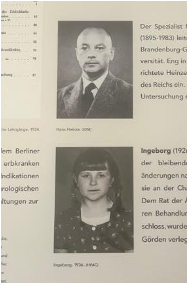
Ingeborg and Hanz Heinze’s photographs in an exhibit in Charité
Several months ago, when I received an email that I was to join a cohort of professionals to visit sites from Nazi history and discuss professional ethics, I felt a morbid eagerness to experience firsthand the moral conflict of a medical professional during the Nazi era. What ethical tensions might they have felt? How would I have responded to systemic injustices at the time? As an avid student of bioethics and a newly minted fourth-year medical student, I thought this was the perfect opportunity to explore what drives the systemic complicity often found in the checkered history of medicine. In my undergraduate philosophy classes, I learned about the Milgram experiments, mob psychology, and theories of moral relativism, and I had long contemplated whether I could have been a Nazi under the same circumstances. Despite this theoretical preparation, I did not anticipate the ensuing assault on my moral sensibilities.
Over the course of two weeks, I walked through sites like the Brandenburg gas chamber and the Auschwitz barracks, now transformed into exhibits communicating the atrocities that occurred in the camps. Driven by an instinct honed in medical school to preserve intellectual clarity by warding off emotions, I attempted to maintain a sense of hardened objectivity and academic curiosity. I had always taken pride in my ability to use my words as a weapon and shield against moral chaos, a way to make sense of the world’s ethical complexities. But as I stood next to the Auschwitz railroad mere feet away from where a Nazi doctor stood 80 years ago, directing prisoners towards the gas chambers, my words slipped away from me. I stared in silent incredulity at photographs of young children like Ingeborg, who clung to their mothers as they were unknowingly herded to their execution. I was morally dumbstruck by how anyone, least of all a doctor, could be complicit in such evil. As I sobbed silently in the middle of the vast encampment, I felt a paralyzing sense of defeat before this giant killing machine that had devoured millions of lives in the name of an ideology. What could my individual resistance have done to change the outcome of a system designed so effectively to execute its programming?
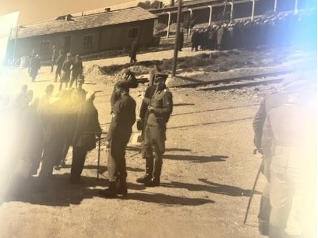
A Nazi doctor directs prisoners to the gas chambers

Auschwitz-Birkenau encampment
For several weeks after I returned from Poland, I remained morally paralyzed, unable to make sense of what I had witnessed—how Auschwitz was made possible while doctors stood by, or worse, eagerly participated. An eerie sense of familiarity crept into my mind as I began to replay scenes from my own medical training with a newfound sense of hopelessness spurred by my own silence: watching in horror as my resident spoke coolly about scheduling a cholecystectomy to a red-faced patient keeling over in pain after brutally maneuvering his abdomen to check for cholecystitis; hearing a fellow medical student join in the residents’ clamor to fight a family member who was fiercely advocating for her mother with limited care options; smiling half-heartedly as an attending rolled his eyes at me upon seeing a patient’s name who was notorious for “being difficult.” My role as a medical student was like that of a fly: insignificant, often annoying, relegated to this lowly position in the kingdom of medicine. Speaking out, even anonymously, often meant risking your reputation, if not among the medical team, then perhaps among your peers who would view it as a weakness, an inability to handle the heat. If you want to succeed, you should know when to accept reality and shut your mouth.
“Anyone have any comments?” A FASPE faculty member posed this question at a reunion event some months later to inquire how people were processing current events in relation to their experience at Auschwitz. While everyone took turns explaining their anger, their hopes, and the productive ways they found to channel their passion, I fell silent as I realized I still had no solution to my feelings of powerlessness. As I desperately rummaged through my mind to find an antidote to this suffocating silence, I recalled the actions of Otto Krayer, a German physician who vocally refused to take the professorship of a Jewish colleague who had been ousted from his post. Krayer’s action represented one of the rare moments of moral dissent by a German academic in Nazi Germany. It also didn’t change the outcome, as the position was filled by another professor, and Krayer was banned from German universities. Nevertheless, through the retrospective lens of history, we remember Krayer for admirably adhering to his personal convictions despite the cost to his career. Krayer didn’t define his moral agency based on the outcome of his actions but rather by the principles he stood up and spoke out for.
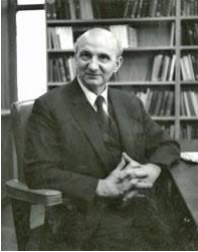
Otto Krayer
Even if his individual act of resistance did not, and probably could not, change the system that contravened his moral beliefs, Krayer refused to remain morally paralyzed, for inaction and silence would have led to complicity. I mused about how his colleagues might have reacted to his actions. Would they have thought him brave? More likely they would have thought him foolish for needlessly sacrificing his career when he could have quietly accepted the position. Krayer had nothing to show for his brazen rejection of the offer, so why did he do it?
In that moment, I realized that my very own fear of powerlessness had kept me truly powerless to take moral action. Too often, I have seen my peers make the same calculus in private: med students can’t change anything, so why bother? This self-fulfilling prophecy paralyzes our moral agency, and medical students are often all too happy to cooperate with whatever the system demands of us in order to be accepted into the exclusive cohort of doctors. Moral paralysis is oddly comfortable because it not only absolves us of the responsibility to attempt change, but it also encourages us to adopt the very attitudes held by our superiors to fast-track our acceptance into their community. Maybe one day, when we are higher up on the ladder of medicine, we will have enough power and security to tentatively suggest a change. At least, that’s what we think.
But I have witnessed the dangerous endpoint of this ethical procrastination. These ruminations on Auschwitz have taught me that it never becomes easier to be the first or even the only one to speak up against moral injustice, and that often such bravery will not change a system as powerful as medicine. However, Otto Krayer was not paralyzed by fear of his own powerlessness but driven by his own convictions. For a medical student, this doesn’t mean one should torpedo one’s career before it’s even begun. But perhaps it means taking a small step to offer an apology to a patient in pain, providing empathetic words of support to a struggling caregiver, or continuing to build bridges with a patient others might deem too difficult. These actions may be rejected, even discouraged, but they are to be undertaken with respect to one’s own convictions. That in and of itself, regardless of the outcome, constitutes a virtuous, worthy act of bravery and self-honesty.
The ethical duties of a physician are theoretically straightforward: respect patient autonomy, do no harm, and act justly. The reality of medical training and practice, on the other hand, is far more complex. Systemic and hierarchical challenges offer every reason to remain silent and resist change. Yet, in the face of vast political and medical systems, nothing makes us more powerless than the belief that we are. Otto Krayer understood this lesson and resisted the Nazis because of his fidelity to his own morality. Krayer’s actions remind me that in moments where I may be struck by the fear of ethical paralysis, I can consult my own moral compass and summon the courage to do what is right. And, if enough of us can find that courage together, we might transform that fear into movement, turn paralysis into change.
Will J.W. Choi was a 2025 FASPE Medical Fellow. He is a medical student at the Warren Alpert Medical School of Brown University.
Notes
- https://encyclopedia.ushmm.org/content/en/article/euthanasia-program.
- Goldstein, Avram. Otto Krayer (1899-1982): A Biographical Memoir, National Academy of Sciences, Washington, D.C., 1987, p. 153. The author has permission to use all included images.