This year marks the 50th anniversary of the “Report of the Ad Hoc Committee of the Harvard Medical School to Examine the Definition of Brain Death.” Motivated by the number of patients in hospitals that were permanently unconscious but retained biological function, this document outlined a definition and criteria for determining brain death. The criteria included confirming the patient is unconscious and cannot respond or perceive stimuli, loss of key brainstem functions, and that all reversible causes have been ruled out. The wide acceptance of the concept of brain death proposed in the Harvard Report then led to significant advancements in the field of organ donation. Patients determined to meet the criteria for brain death who have consented to organ donation are the ideal source of organs, as circulation can be maintained until organ procurement takes place. The concept of brain death has been controversial since its origins, but with technology advancements that allow organs to remain viable for longer periods without a beating heart, does the definition still stand the test of time?
News outlets covering the highly-political issue of abortion rights struggled to hit the mark while reporting on the new legislation in Alabama this May. A piece by Alexandria Neason in the Columbia Journalism Review criticized the coverage as short-sighted and damaging to related coverage on maternal health. Both local and national journalists who report on maternal health spoke out on how the national outlets sensationalized the signing, making it seem as if the law crept from nowhere despite significant work by both proponents and opponents leading up to its passage. National coverage also caused confusion, with many outlets failing to explain that the law won't go into effect for another year. Women who misunderstand might not seek treatment they can still receive for that time.
“News publications can make it seem like a doomsday,” writer Clarissa Brooks said in the CJR piece. She added that it appeared the media didn't pick the story up until the final votes.
This spotlighting of abortion rights can leave reporting on other issues in women's and reproductive health in the shadows, as reported by journalists like Anne Claire Vollers. Writing for Alabama Media Group, Vollers is spending the next year covering the consequences of inadequate access to maternal health care in the state, an issue related to but not connected to the new abortion ban. When writing about politically charged news, journalists need to seek an understanding of not only the story of the moment, but also the larger implications that otherwise might go unreported. This is especially concerning when the topic involves critical issues today like maternal health.
NEW YORK, NY –
Fellowships at Auschwitz for the Study of Professional Ethics (FASPE) announced
today that Dhruv Khullar will be named Distinguished Fellow for 2019 and
receive a FASPE Award for Ethical Leadership. Khullar will be presented the
award at FASPE’s annual gala and awards dinner on Monday, April 15 at CNVS in
New York City.
Khullar,
MD, MPP, is being honored as a Distinguished Fellow by FASPE for his broad
reach in bringing public awareness to key issues in medical ethics through his
writing for lay publications and his policy work.
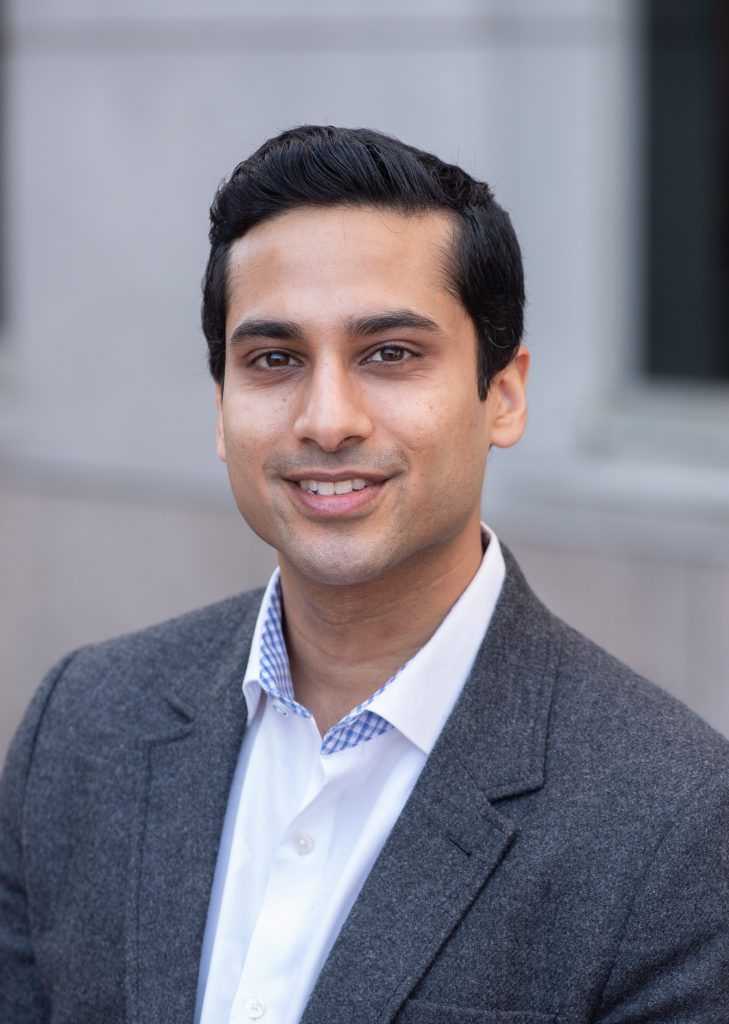
Dr. Dhruv Khullar, a 2012 FASPE Medical Fellow, is being honored by FASPE with a Distinguished Fellow Award at the 2019 FASPE Annual Awards Dinner on April 15. (Photo Melanie Einzig)
Khullar,
an assistant professor of healthcare policy and research at Weill Cornell
Medicine, is a frequent contributor to The
New York Times, as well as other lay and academic publications,
where
he explores the intersection of medicine, health policy and economics. In 2012,
Khullar was a FASPE Medical Fellow.
“In many respects, our Distinguished Fellow honor is the most important
of our annual Ethical Leadership Awards,” said David Goldman, Founder and
Chair of FASPE, which runs innovative fellowship programs that challenge
graduate students and early-career professionals in business, journalism, law,
medicine and religion to confront their ethical responsibilities.
“With this award we recognize a Fellow who has gone on to exemplify
FASPE’s mission of ethical leadership. Khullar leads through his widely-read
writings, which address a range of issues at the heart of medical ethics today
and which challenge us to engage in thoughtful and transparent debate. We are
proud to acknowledge Khullar’s important contributions in exploring traditional
areas of medical ethics as well as those arising from the use of new
technologies.”
Khullar, who holds a medical degree from the Yale School of
Medicine and a master’s degree in public policy from the Harvard Kennedy
School, recently worked in the ABC News Medical Unit, helping to communicate
evolving health stories, and was previously at the White House Office of
Management and Budget (O.M.B.), focusing on Affordable Care Act implementation.
In addition to The New York Times, Khullar
has written for publications such as The
Washington Post, The Wall Street Journal, USA Today, The Atlantic, Slate,
Health Affairs, the New England
Journal of Medicine, the Journal of
the American Medical Association (JAMA). He currently serves as a Senior
Research Fellow at NYC Health + Hospitals, and as Director of Policy
Dissemination at the Physicians Foundation Center for Physician Practice and
Leadership.
“FASPE was such a
powerful experience and one that I have thought about frequently over the
years,” said Khullar. “Those relationships, lessons and insights have only
grown stronger and more relevant with time. It is an honor to be recognized by
an organization that has given me, and many others, so much. I am deeply
grateful."
FASPE is presenting Awards for Ethical
Leadership to two other honorees at its gala. The global consulting and
professional services firm Accenture is this year’s Corporate Honoree. Accenture
is being recognized for its leadership in applying ethical principles to the
development and use of artificial intelligence and other innovative 21st-century
technologies. The Posthumous Honoree will be Fritz Bauer, the late judge and
prosecutor who prosecuted Nazi officials following World War II in German
courts, despite active opposition from his superiors.
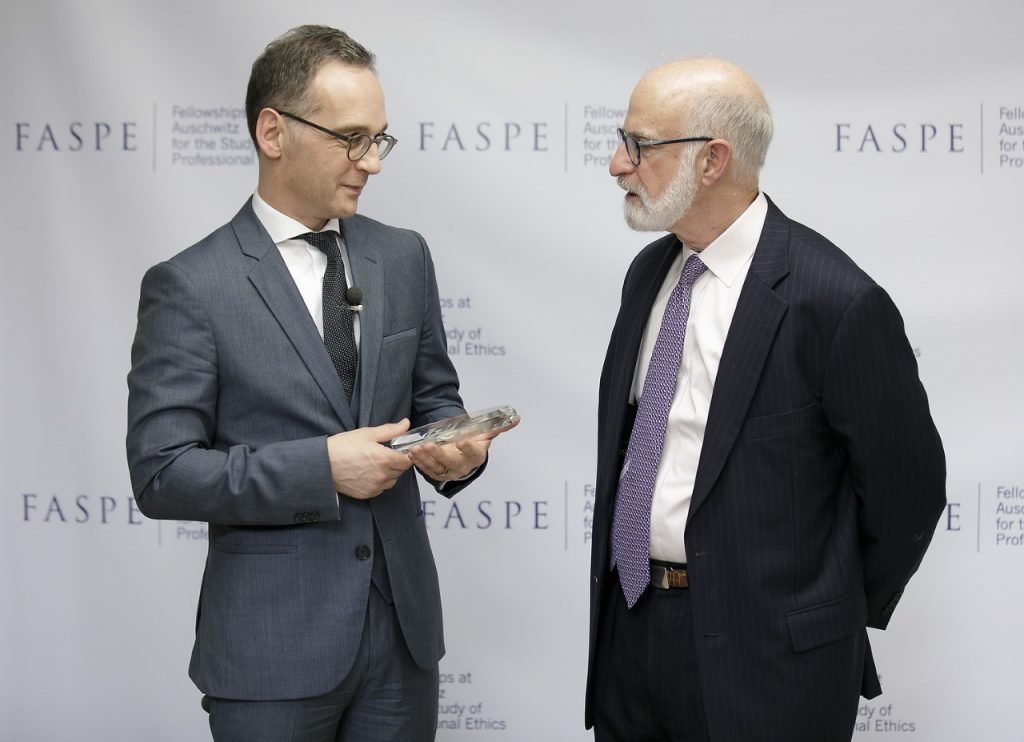
At a private reception at LRN on April 2, German Foreign Minister Heiko Maas accepted FASPE Posthumous Award for Ethical Leadership on behalf of the late German-Jewish prosecutor and judge Fritz Bauer. David Goldman, Chair and Founder of FASPE, presented the Award to Maas.
German Foreign Minister Heiko Maas accepts the Posthumous Award for Ethical Leadership on behalf of Fritz Bauer. FASPE Chair and Founder David Goldman presented the Award to Maas. PHOTOTHEK/THOMAS INO
Fritz Bauer (1903 – 1968) was a German-Jewish judge and prosecutor who prosecuted Nazi officials following World War II in German courts, despite active opposition from his superiors. Raised in Stuttgart, Bauer became Germany’s youngest judge in 1930 at the age of 26. In 1933, he was dismissed from his position and arrested and imprisoned for political activity against the Nazi party. Bauer fled to Denmark in 1935 and later to Sweden. After the war, in 1949, Bauer returned to Germany, eventually becoming the chief prosecutor for the State of Hessen. He focused his career on reforming the German justice system and bringing Nazi officials to trial at a time when Nazis continued to hold key government positions and anti-Semitism continued to pervade German society. Bauer set in motion the arrest of Adolf Eichmann in 1960. He is probably best known for the Frankfurt Auschwitz Trials, which began in 1963 and brought to trial 22 former officials of the Auschwitz-Birkenau death camp.
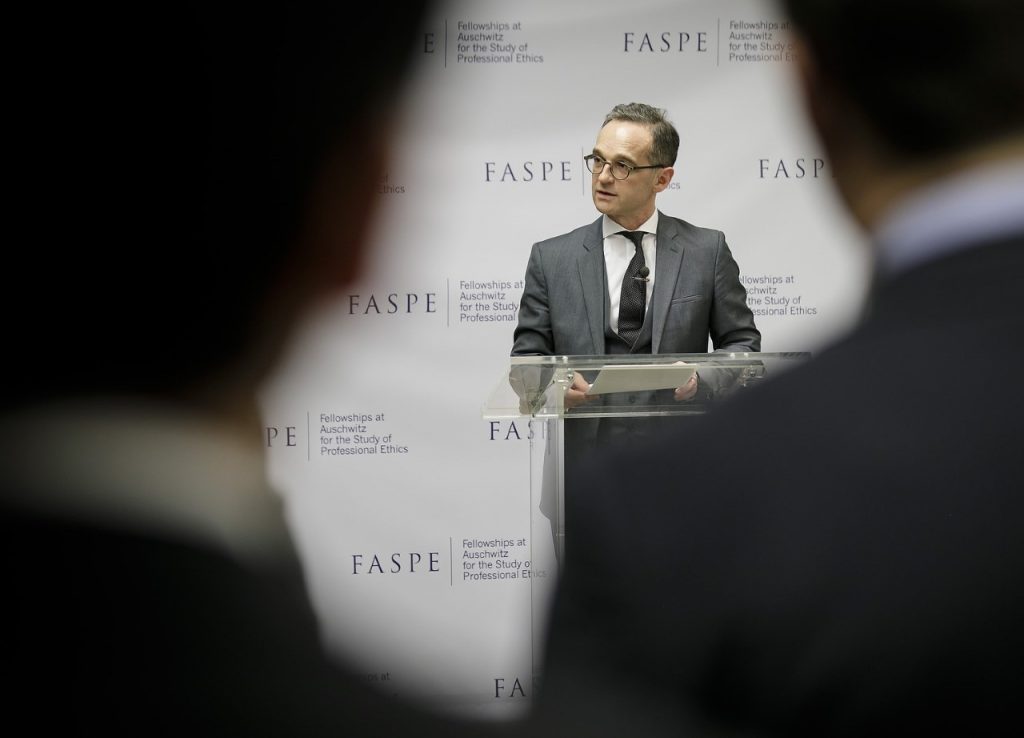
German Foreign Minister Heiko Maas speaks at the reception honoring Fritz Bauer with the FASPE Posthumous Award for Ethical Leadership. PHOTOTHEK/THOMAS INO
Maas is widely
known for championing Bauer’s legacy. In 2015, when he was Minister of Justice
and Consumer Protection, Maas established the Fritz Bauer Thesis Award for
Human Rights and Contemporary Legal History. Maas has also said that the legacy
of the Holocaust was pivotal to his decision to enter politics.
“I am
deeply honored to accept the FASPE award on Bauer’s behalf,” said Maas, “The
history of the German judiciary doesn’t have many heroes. One of the few was
Fritz Bauer. He stood up for democratic values during the Weimar Republic, rejected
the barbaric Nazi regime and continued his fight for justice in postwar
Germany. Facing suspicion, even hostility, Fritz Bauer stayed true to his
conviction that a democratic Germany could only have a future if it confronted
its shameful past. His belief in justice and his quest for humanity
inspire us, day by day, to stand up for human rights, to defend democratic values
and to protect human dignity itself.”
NEW YORK, NY – Fellowships at Auschwitz for the
Study of Professional Ethics (FASPE) announced today that Accenture is this
year’s Corporate Honoree for the Award for Ethical Leadership, which will be
presented at FASPE’s annual gala and awards dinner on Monday, April 15 at CNVS
in New York City.
Accenture,
a global professional services company, is being recognized for its leadership in
applying ethical principles to the development and use of artificial
intelligence and other innovative 21st-century technologies.
Paul Daugherty, Accenture’s Chief Technology & Innovation Officer, will be accepting the Award on Accenture's behalf.
“We
expect ethical leadership from our professionals. They are the influencers in
our communities,” said David Goldman, Founder and Chair of FASPE, which runs
innovative fellowship programs that challenge graduate students and
early-career professionals in business, journalism, law, medicine and religion
to confront their ethical responsibilities. “Accenture is a company that exemplifies
the leadership that is at the core of FASPE’s mission.”
“I
am honored to be accepting this award on behalf of Accenture,” said Paul Daugherty,
Accenture’s Chief Technology & Innovation Officer. “FASPE is an inspiring
organization whose mission to train people to make ethical decisions amid
internal and external pressures is more important than ever.
“At
Accenture, we believe powerful new technologies such as artificial intelligence
will have a huge impact on improving the way every person on the planet works
and lives,” continued Daugherty. “However, this can only be the case if
organizations put digital trust and ethics at the center of their approach. It
is not optional. We are proud of the work that Accenture has pioneered on responsible
AI, providing a vision, framework, approach and tools for our own people and
for other organizations to ensure that AI is applied with a human and ethical
focus.”
Accenture
works at the intersection of business and technology to improve performance and
create sustainable value. Daugherty, who also leads Accenture’s Technology
Innovation & Ecosystem group, oversees the company’s technology strategy
and is engaged in driving its innovation through R&D and by leveraging
emerging technologies.
Presenting the Award for Ethical Leadership to Daugherty will be Mike Eichenwald, an Advisory Leader at the consulting firm LRN and a member of FASPE’s Business Faculty.
Accenture
is dedicating the award to its late CEO, Pierre Nanterme, “whose exemplary vision
and ethical leadership made our work possible,” said Daugherty.
FASPE
is also presenting Awards for Ethical Leadership to two other honorees this
year. The Posthumous Honoree will be Fritz Bauer, the late judge and prosecutor
who prosecuted Nazi war criminals following World War II under German law and in
German courts, despite active opposition from his superiors. And Dhruv Khullar,
MD, MPP, is being honored as a Distinguished Fellow for his broad reach in
bringing public awareness to key issues in medical ethics today through his
writings and public appearances. Khullar, a physician at New York-Presbyterian
Hospital and an assistant professor in the Weill Cornell Department of
Healthcare Policy and Research, was a FASPE Medical Fellow in 2012.
About
FASPE
FASPE provides a unique historical lens to study contemporary ethics
in the professions. Currently entering its tenth year of operations, FASPE’s
Business, Journalism, Law, Medical and Seminary programs engage graduate
students and early-career professionals in an intensive two-week study trip to
Germany and Poland, where they explore contemporary ethical issues in their
respective fields by first studying their professional counterparts in Europe
during the period of 1933-1945. FASPE selects approximately 65-75 Fellows each
year for its five programs through a competitive application process. It
currently has over 500 alumni fellows, many of whom are emerging as leaders in
their fields.
About Accenture
Accenture
is a leading global professional services company, providing a broad range of
services and solutions in strategy, consulting, digital, technology and
operations. Combining unmatched experience and specialized skills across more
than 40 industries and all business functions — underpinned by the world’s
largest delivery network — Accenture works at the intersection of business and
technology to help clients improve their performance and create sustainable
value for their stakeholders. With 477,000 people serving clients in
more than 120 countries, Accenture drives innovation to improve the way the
world works and lives. Visit us at www.accenture.com.
NEW YORK, NY – The Fellowships at Auschwitz for the Study of Professional Ethics (FASPE) will present its 2019 Awards for Ethical Leadership at its annual gala and awards dinner on Monday, April 15, 2019 in New York City. The event will begin at 6:30 pm and will be held at CNVS.
This year, FASPE’s Posthumous Honoree is Fritz Bauer,the late judge and prosecutor who distinguished himself for prosecuting Nazi war criminals following World War II, and in particular, for having been the first prosecutor to bring criminal charges under German law in German courts against officials at Auschwitz, despite active opposition from his superiors.
Heiko Maas, German Federal Minister for Foreign Affairs, will be accepting this year’s posthumous Award for Ethical Leadership on Bauer’s behalf at a private cocktail reception on April 2 in Manhattan. German Consul General David Gill will attend the FASPE gala on April 15 to represent Maas and the German Consulate. Gill also serves as one of the FASPE gala’s honorary chairs.
“We believe there is no individual more deserving of our posthumous Award for Ethical Leadership than Fritz Bauer,” said David Goldman, Founder and Chair of FASPE,which runs innovative fellowship programs that challenge graduate students and early-career professionals in business, journalism, law, medicine and religion to confront their ethical responsibilities by first studying their professional counterparts in Nazi Germany. “Simply put, his actions define ethical leadership within the law—even more so for having been undertaken at personal risk and for the benefit of the larger community.
“FASPE’s choice of the person to accept the award is just as important as the choice of the posthumous honoree himself,” continued Goldman, “We are particularly honored that Minister Maas is able to accept the Award on Bauer’s behalf, as we believe that his entire body of work as a public figure embodies the principles that Bauer stood for.”
Maas is widely known for championing Bauer’s legacy. In 2015, when he was Minister of Justice and Consumer Protection, Maas established the Fritz Bauer Thesis Award for Human Rights and Contemporary Legal History. Maas has also said that the legacy of the Holocaust was pivotal to his decision to enter politics.
“I am deeply honored to accept the FASPE award on Bauer’s behalf,” said Maas, “The history of the German judiciary doesn’t have many heroes. One of the few was Fritz Bauer. He stood up for democratic values during the Weimar Republic, rejected the barbaric Nazi regime and continued his fight for justice in postwar Germany. Facing suspicion, even hostility, Fritz Bauer stayed true to his conviction that a democratic Germany could only have a future if it confronted its shameful past. His belief in justice and his quest for humanity inspire us, day by day, to stand up for human rights, to defend democratic values and to protect human dignity itself.”
FASPE is also presenting Awards for Ethical Leadership to two other honorees this year. The global consulting and professional services firm Accenture is this year’s Corporate Honoree. It is being recognized forits leadership in applying ethical principles to the development and use of artificial intelligence and other innovative 21st century technologies. Physician, researcher, author and 2012 FASPE Medical Fellow Dr. Dhruv Khullar will be named Distinguished Fellow. Khullar isbeing honored for his broad reach in bringing public awareness to key issues in medical ethics today through his writings and public appearances.
About FASPE
FASPEprovides a unique historical lens to study contemporary ethics in the professions. Currently entering its tenth year of operations, FASPE’s Business, Journalism, Law, Medical and Seminary programs engage graduate students and early-career professionals in an intensive two-week study trip to Germany and Poland, where they explore contemporary ethical issues in their respective fields by first studying their professional counterparts in Europe during the period of 1933-1945. FASPE selects approximately 65-75 Fellows each year for its five programs through a competitive application process. It currently has over 500 alumni fellows, many of whom are emerging as leaders in their fields.
The Fellowships
at Auschwitz for the Study of Professional Ethics (FASPE) will present its 2019
Awards for Ethical Leadership at its annual gala and awards dinner on Monday,
April 15, 2019 in New York City. The event will begin at 6:30 pm and will be
held at CNVS.
This year’s honorees are Accenture,
a global consulting and professional services firm working at the intersection
of business and technology; Fritz Bauer
(posthumously), who prosecuted Nazi war criminals in Germany following
World War II and spearheaded justice reforms; and Dhruv Khullar, a physician, researcher and author, who will be
named this year’s Distinguished Fellow.
“Our honorees exemplify the ethical leadership that is at the
core of FASPE’s mission,” said David Goldman, Founder and Chair of FASPE, which runs innovative fellowship
programs that challenge graduate students and early-career professionals in
business, journalism, law, medicine and religion to confront their ethical
responsibilities.
“Professionals are the influencers in our communities and our
leaders,” continued Goldman, “FASPE seeks to provide future leaders with the
tools to identify ethical dilemmas, to pose the right ethical questions and to
ensure that they do not ignore the ethical consequences. The stakes today are
too high to ignore—from artificial intelligence, to genetic manipulation, to
the proliferation of fraudulent news sources and much more.”
Accenture, is being recognized by FASPE for its leadership in applying ethical principles to the development and use of artificial intelligence and other innovative twenty-first century technologies. Fritz Bauer is being recognized posthumously for having been the first prosecutor to bring criminal charges under German law in German courts against officials at Auschwitz, despite active opposition from his superiors.
Dhruv Khullar, MD, MPP, is being honored as a Distinguished Fellow for his broad reach in bringing public awareness to key issues in medical ethics today through his writings and public appearances. Khullar, a physician at New York-Presbyterian Hospital and an assistant professor of medicine and an assistant professor of healthcare policy and research at Weill Cornell Medicine, is a frequent contributor to The New York Times and other publications, where he explores the intersection of medicine, health policy and economics. In 2012, he was a FASPE Medical Fellow.
The FASPE Gala Honorary Chairs are Paul R. Daugherty, Chief Technology & Innovation Officer at Accenture; David Gill, Consul General of Germany in New York; Joanne Waldstreicher, MD, Chief Medical Officer at Johnson & Johnson; David L. Taub of McDermott Will & Emery LLP; and Patrick Faller of Mayer Brown LLP. Tables start at $10,000. Tickets are now available and may be purchased at www.faspe-ethics.org/gala.
About FASPE
FASPEprovides
a unique historical lens to study contemporary ethics in the professions. Currently
entering its tenth year of operations, FASPE’s Business, Journalism, Law,
Medical and Seminary programs engage graduate students and early-career
professionals in an intensive two-week study trip to Germany and Poland, where
they explore contemporary ethical issues in their respective fields by first
studying their professional counterparts in Europe during the period of
1933-1945. FASPE selects approximately 65-75 Fellows each year for its five
programs through a competitive application process. It currently has over 500
alumni fellows, many of whom are emerging as leaders in their fields.
Nathan Phillips prays with other protesters near the main opposition camp against the Dakota Access oil pipeline near Cannon Ball, North Dakota, U.S., February 22, 2017.
Journalism values accuracy and facts. But as videos go viral on social media and are accepted by their vast audiences as indisputable evidence of what occurred at a certain place and time, the line of what journalists use to back up their reported facts has started to blur into questionably ethical territory. Seasoned Atlantic writer James Fallows fell into this trap when publicly commenting on a video that appeared to depict a confrontation between a group of high school students from Covington Kentucky and a Native American elder in front of the Lincoln Memorial in Washington, D.C. on January 18, 2019.
Before obtaining a fuller picture, numerous media outlets were quick to criticize the Covington Catholic High School students for taunting the Native Americans on the Mall, but then reversed their position when more videos and information surfaced. The incident serves as a useful demonstration of the tensions in journalism between speed and accuracy and between reporting based on perception and on provable fact. It also highlights the power of social media to time and again tempt us to react to a controversy without the requisite humility and courtesy we might afford one another in a face-to-face disagreement.
The Senate’s consideration of William Barr for Attorney General has brought renewed attention to the legal rules and ethical norms that apply to the recusal of government attorneys and to the independence of law enforcement officials. At this time, it is worth revisiting the commitments made by attorneys Elliot Richardson and William Saxbe when they were nominated, successively, by Richard Nixon to be attorney general during the Watergate investigation. Famously, Richardson committed to “pursue the truth wherever it may lead” and to do so “without fear or favor and with regard solely to the public interest.” In other words, legal rules and ethical norms must apply irrespective of the politics of the day or the identity of the President.
Should the Attorney General and other government attorneys be asked to go above and beyond statutory requirements and the rules of professional responsibility? How should the Attorney General balance Department of Justice policy and a broader obligation to the public interest? Can we find guidance in other ethical frameworks, such as the Indian concept of dharma, which suggests that when civic and private interests conflict one should prioritize civic responsibilities?
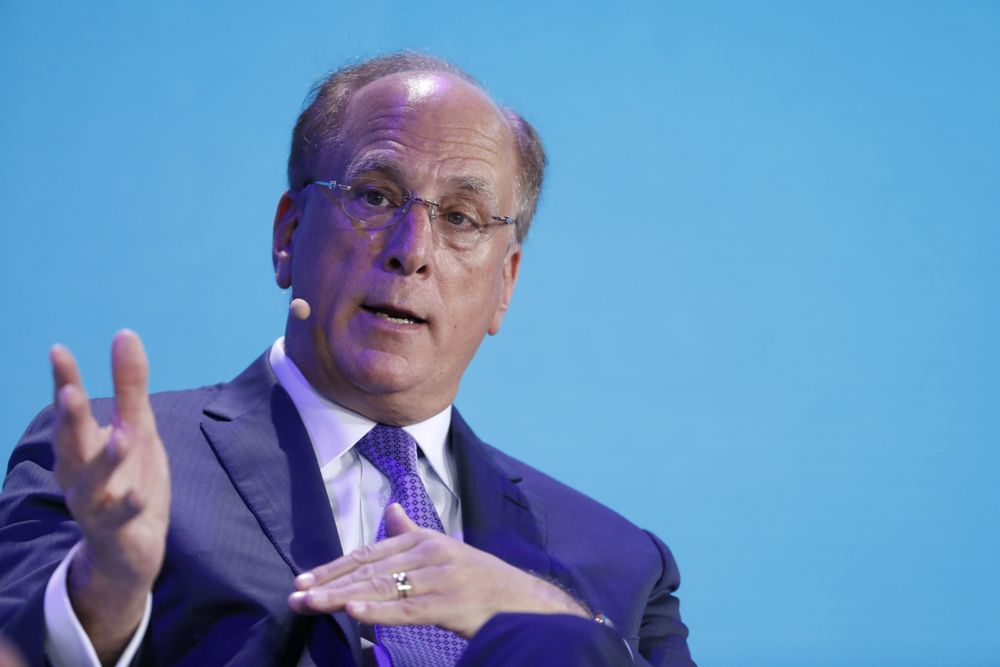
In a world in which democratically elected governments seem increasingly unable to enact policy while large companies exercise outsized influence, what is the appropriate role of a corporation? Is it solely to maximize profits? The world’s two largest asset management companies made headlines this month: Vanguard Group for the passing of its founder John C. Bogle, who popularized the index fund, and BlackRock Inc. for Larry Fink’s annual letter to CEOs. Institutional investors, such as Vanguard and BlackRock, now own approximately two-thirds of U.S. equities and thus can exert broad influence over managerial practices. While Fink’s motivations and effectiveness may be debated, institutional investors will continue to shape discussions of corporate purpose. This op-ed examines Fink’s call to view social purpose as a company’s “fundamental reason for being” and as inextricably linked with profitability.
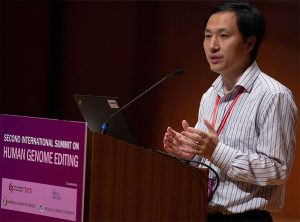
He Jiankui, a Chinese biophysicist, claims that he has edited twin human embryonic genomes with a new technology called CRISPR-Cas9 to produce the first humans born with artificially edited genomes. The reception by the scientific community has been primarily one of intense criticism. Despite being impressed by He’s state-of-the-art technology, leading researchers have described this as a “failure of self-regulation.” He’s work raises questions regarding how broadly a medical researcher’s responsibility extends to the potential unintended consequences of his or her work and how critical is that researcher’s obligation to existing patients who may benefit from unrefined research and technology.
He, a researcher at China’s Southern
University of Science and Technology, edited a gene, named CCR5, which provides
the route by which HIV infects the immune system. Given the high prevalence of
HIV in China, removing both copies of CCR5 would theoretically protect someone
from contracting HIV. One of the twins, whose genome He manipulated, had both
copies of the gene removed, while the other only had one gene successfully
removed by the technology (meaning that he would still be at risk for HIV).
Regardless of this difference, the parents decided to have both embryos
implanted in the mother.
The literature regarding the ethics of
gene editing usually breaks down into a discussion regarding cure vs
enhancement. Interestingly, He’s actions are an example of enhancement for the
sake of disease prevention.
The backlash has been severe. Some have stated flatly that this technology was not ready for human application, while others wished He had targeted other genes for elimination that would cure a disease, like Huntington’s or Tay-Sachs. The Chinese Academy of Sciences has condemned this work, the top scientific societies in China have stated that He violated human rights laws, and Francis Collins (director of the US National Institute of Health) has called for the development of a “binding international consensus” to regulate this type of research. A secondary ethical dilemma wrapped into this case is how scientific norms are discovered, agreed upon, and enforced, and whether medical scientists are bounded by these norms even at the potential expense of a particular patient.
“For the one in authority is God’s servant for your good.” This line of Scripture taken from Romans 13:04 lies at the intersection of religious and civil law. It also lies at the heart of a piece by Basyle J. Tchividjian, executive director of Godly Response to Abuse in the Christian Environment (GRACE), who argues that religious leaders are obligated to work with the proper civil authorities and professional experts to address allegations of sexual abuse swiftly, thoughtfully, and with as much dignity and respect as possible for the victimized child. In Jewish tradition, the concept of dinad'malkhuta dina—the law of the land is the law—speaks to the same matter. Tchividjian advocates for having policy protocols in place at schools and places of worship, addressing the concerns of the wider community, and placing the needs of the victim first.